2026 Elimination Eval: Utah Mammoth
In what was technically the first playoff berth in franchise history, the Mammoth pushed a star-studded Vegas team to six games.

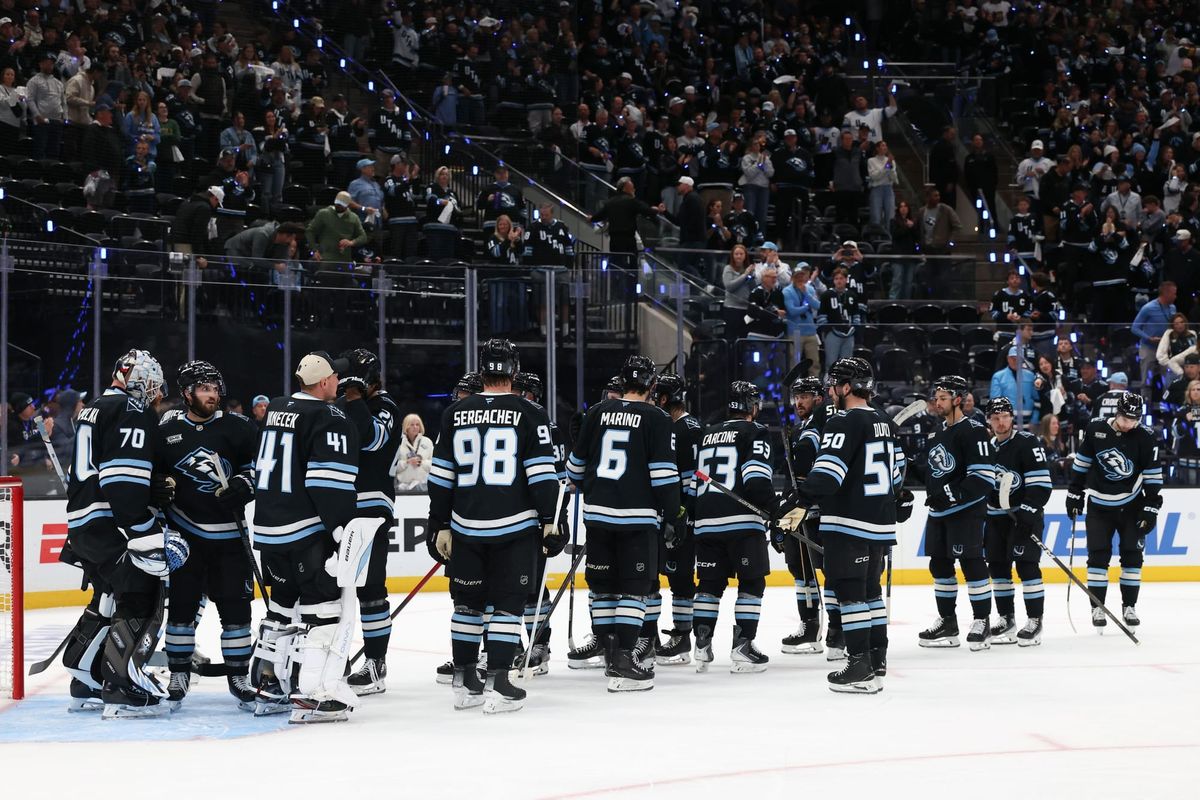
In just their second season in the league, the Utah Mammoth made the postseason for the first time in their franchise history. Four players on their roster, however, were there when the their previous incarnation, the Arizona Coyotes, last made the playoffs in 2020 (Barret Hayton, Lawson Crouse, Nick Schmaltz, and Clayton Keller).
If this seems slightly confusing to you, that's because the Mammoth are technically an expansion team, but the foundation of the roster was extracted from that Coyotes franchise, who may or may not return at some point in the near or distant future. Like I said: confusing.
What’s not confusing, is why this team is finally exciting to watch again. Led by a young core of future stars, this may have been the Mammoth’s first playoff appearance, but it certainly won’t be their last.
Expectations
The general consensus surrounding this Utah Mammoth team was that they were a young group on the rise and could compete for a wild card spot as early as this season. That was what we all essentially agreed with here at Blueshirt Banter, seeing as six of the seven of us who participated in standings season preview had the Mammoth finishing the season as a wild card team. While the expectations were higher for them heading into this season, they really didn’t make a ton of moves to prepare for it. The Mammoth did, however, seem to value quality over quantity in their transitions.
Free agency mainly consisted of minor moves, and while those certainly provided Utah with valuable depth, they weren’t needle movers in any sense. They did add a pair of coveted depth veteran players in Brandon Tanev and Nate Schmidt, who were both signed to three-year deals. It was really what happened on the trade front that made Utah a serious playoff team in the Western Conference.
Acquiring JJ Peterka over the summer for Michael Kesselring and Josh Doan seemed like a slam dunk—although given the success Doan has had in Buffalo, perhaps it wasn’t as much of one as previously through. Peterka was a clear solution to get more goals out of your forward group and another encouraging step in getting this team back to the playoffs. At the deadline, the Mammoth made another big move, sending Olli Maatta and a prospect along with three second round picks to the Calgary Flames for one of their longest tenured players, MacKenzie Weegar. Utah may not pick in the second round again anytime time soon, but when you get the chance to come out of the trade deadline with a top pair defenseman, you take advantage of that opportunity, no questions asked.
Series Recap
Utah got off to a strong start in this series, opening the scoring at the end of the first period in Game 1. It was Logan Cooley picking up not only the first playoff goal of his career, but the first playoff goal in Utah’s franchise history. Picking up the assists on the milestone goal were Nate Schmidt and Lawson Crouse. The lead would only last for about four minutes as Colton Sissons tied it up for Vegas early in the second. While Kevin Stenlund regained the lead for Utah, three unanswered goals from Vegas gave them the win in Game 1 by a score of 4-2. It was a physical game from start to finish, with Vegas being credited with over 50 hits and Utah wit 29. The Mammoth did not back down from the challenge which was evident right through the final buzzer as the game ended with another big scrum.
Trailing midway through the opening period of game two, MacKenzie Weeger tied the game up for Utah with three minutes to go in the period. Late in the second, Dylan Guenther gave the Mammoth a brief lead, but it was Ivan Barbashev tying the game back up at two just 62 seconds later. The game would be decided in the third period as Cooley picked up the second of his postseason off a rebound to even up the series. Cooley—who very well could have been in more serious Olympic consideration for Team USA had he not missed over a quarter of the season with an injury—is stamping his name all over the Mammoth’s history books, as his goal became the game winner in the franchise’s first ever playoff win. Cooley also became the youngest American born player to score in both of his first playoff games.
Game 3 was the high moment for the Mammoth as they took their first and only lead in the series. While Weegar and Guenther both picked up their second of the playoffs to give Utah a 2-0 lead heading into the second, it was back-to-back goals from Crouse just five minutes apart that put this one out of reach for Vegas. Jack Eichel and Nick Dowd added to the Golden Knights side of the scorecard, but Karel Vejmelka held down the fort in net, making 30 saves on 32 shots. The Mammoth on the other hand, finished the game with just 12 shots on goal.
Game 4 would be the game-changing moment of the series. An outing decided in overtime, had Utah been able to pull off the win, who knows how the rest of the series could have played out. Pavel Dorofeyev put Vegas on the board just 72 seconds into the game and former friend Brett Howden—who again is having a tremendous postseason—picked up his first of the playoffs on the penalty kill. Trailing 2-0 into the second, Cole Smith made it a 3-0 game for Vegas, but a pair of goals 29 seconds apart brought Utah within one heading into the third. Michael Carcone converted less than two minutes into the period to tie it and less than four minutes after that, it was Clayton Keller giving the Mammoth their first lead in the game. Then it was Brett Howden again, tying the game midway through the third to send it to overtime.
In one of the weirder moments of the first round of these playoffs, Vegas actually scored not once but twice in the overtime period. Dorofeyev found the back of the net midway through the first overtime, but the goal was waived off because the play was determined to be offsides. This was Utah’s chance at redemption, but just as the overtime period was winding down, a shot from Shea Theodore from up top found the back of the net. This time it would count to tie up the series.
Overtime would not be a strength for Utah as the low moment came in their Game 5 loss, five and a half minutes into the second overtime period. While goals from Carcone, Guenther, Crouse, and John Marino helped Utah lead throughout the night, a hat-trick from Dorofeyev and another goal from Theodore forced overtime. As the first overtime came and went, it was Brett Howden finding the back of the net with another shorthanded goal to give Vegas the victory. Both teams had 38 shots on goal and were north of 40 hits in what was becoming quite a physically taxing series.
If Game 5 wasn’t the low point, Game 6 obviously was, as Howden opened the scoring late in the first and Mitch Marner extended the lead to two in the final minute of the second period. While Kailer Yamamoto brought the Mammoth back within one early enough in the second, Sissons tied it up for Vegas two minutes later, and a power play goal from Marner helped decide the game. Cole Smith added salt to the wound with an empty net goal as Utah’s first venture into the playoffs would come to an end.
Prediction
For the most part, we were all on the same page, as four of the five of us that participated in our quarterfinal roundtable had Vegas winning the series. While I was pulling for Utah, I was right on the money saying Vegas in six. Utah definitely had moments where they looked as though they could take Vegas out. But in the end, the experience prevailed and the Golden Knights took care of business before the series could get to a game seven.
Was the Season a Success?
It’s not common for teams to go on these magically deep playoff runs in the first season they're back in the playoff picture. Making the playoffs this season ultimately felt like the goal Utah set out to achieve. While anything can happen once the playoffs start, I'd imagine that once the dust on the loss settles, this is a campaign this group can look back on and be proud of.
The goal moving forward will be for losing in the first round to act as the fuel that fires them up for a longer playoff run next season. As it stands now, I'd absolutely say the Mammoth had a successful season and are right on track for what they are looking to progress towards.
UFA’s/RFA’s
Barret Hayton is the team’s only pending RFA, but their list of UFA’s is significantly more substantial. The list includes bigger names like Alex Kerfoot, Kevin Stenlund, and Kailer Yamamoto—who was tied for the team lead in points during the postseason. Additionally, the Mammoth have Ian Cole, Nick DeSimone, goaltender Vitek Vanacek, and old friend Kevin Rooney all expected to hit the open market this summer.
Generally speaking, I’d say Utah can get on without most of these names. But given the success Yamamoto found with them down the stretch, you’d have to think he’d be worth extending.
Biggest Question Moving Forward
The good news is that Utah doesn’t have any major questions in a concerning way. That being said, their biggest question moving forward in my opinion is, what big swing do they take to get them back into the playoffs in order to better compete with teams like Vegas, Colorado, Minnesota, Dallas, and Edmonton? The Central Division alone is going to be brutal to compete in with three of those aforementioned teams leading the charge. Can Utah do something to be taken a bit more seriously? In their inaugural season, they made a big splash in acquiring Mikhail Sergachev. This year, they began the season by turning Kesselring and Doan into JJ Peterka and went on to acquire Mackenzie Weeger at the deadline. What options do they have moving forward and what is their biggest area of need?
I’m a fan of Karel Vejmelka, but they definitely need to start thinking about the future in net. Beyond that, they’re likely still one top-four defenseman away from really being considered a complete team. There’s a chance a younger defenseman like Dmitri Simashev or one of Artyom Duda or Maveric Lamoureux can take a step in that direction. But if I’m Utah, I’d consider shopping a Tij Iginla or Cole Beaudoin to try and add either a defenseman or goalie. They have Schmaltz and Cooley locked in down the middle-to-long term, and they’ll likely extend Hayton to be their third line center. If they keep Yamamoto around or move another one of those young players into a middle-six role next season, their forward group is solid.
Projected Lineup
Keller - Schmaltz - Crouse
Yamamoto^ - Cooley - Guenther
But - Hayton* - Peterka
Tanev - McBain - Carcone
O’Brien
Sergachev - Weegar
? - Durzi
Schmidt - Marino
Simashev
Vejmelka - ?
Next in line:
- Forwards: Caleb Desnoyers, Cole Beaudoin, Tij Iginla
- Defenseman: Maveric Lamoureux, Artyom Duda, Tomas Lavoie
(*-RFAs) (^-UFAs)
Final Thoughts
When I think about the Mammoth, all I can think about was the moment the news broke about the Sergachev trade. That was a move that indicated they weren’t here to mess around. They were ready to compete and make a name for themselves. They’ve only further proved that by going after Peterka and bringing on Weegar. This is a team that has a fantastic core of young players, even more prospects in the pipeline that can shape out the roster in the future, and a strong balance of middle-of-the-pack guys that can keep them competitive moving forward.
For what it’s worth, Utah had six players on their roster tied with five points for their team lead throughout these playoffs. Beyond that, Nick Schmaltz had four points, Cooley had three, three other players had at least two points, and five others had at least one. This was a team that was getting contributions up and down their lineup. Of the four skaters who were held pointless, only two of them played in all six games—one of which being Peterka. You have to think—or at least hope—that his lack of production in the postseason had to have been a fluke and as long as he can continue to put up 40-50 points for them, on top of the contributions from top guys like Keller, Cooley, Guenther, and Schmaltz, they’ll be in good shape.
As mentioned, I’d like to see them make another big move to either acquire a second pair defenseman to play on Sean Durzi’s left or a younger goalie that can help out Vejmelka and potentially take over as their number one down the road. It’s always difficult to predict goalie trades but if Minnesota looks to move Filip Gustafsson to allow Jesper Wallstedt to be their full time starter, you’d have to think Bill Guerin could be swayed if it meant bringing back a young center like Tij Iginla. Or perhaps you get creative and find a lower risk trade to attempt to improve that positional depth. Of course, they could always count on Vejmelka, sign a capable backup and draft one.