2026 Rangers Report Card: Brett Berard
Zero points in 13 NHL games. Six recalls, six reassignments. The breakout that never came—and an RFA summer ahead.
This article is part of an ongoing series of Rangers Report Cards, grading the performance of each member of the 2025-26 New York Rangers. To view more report cards in this series, go here.
To read the Season Preview for Brett Berard, go here.
There's an old poker saying: Don't fall in love with your hand.
I fell in love with my hand.
Back in August, I wrote roughly 2,000 words arguing that Brett Berard was a lock for the opening night roster, a "$3-4 million player at a fraction of the cost," I noted.
The embodiment of everything Mike Sullivan would want in a New York Ranger.
I cited the G/60 numbers. I cited the individual points percentage. I cited the torn labrum he played through like some kind of folk hero. I told you to mark it down.
October 2025. Opening night at Madison Square Garden. Berard in the lineup.
He was the last roster cut out of training camp.
What followed wasn't just a disappointing season—it was the kind of existential identity crisis that makes you wonder whether the player you fell in love with from the underlying metrics ever actually existed, or if you'd just been projecting a narrative onto a 14-game AHL scoring drought in a trench coat.
Expectations
The case for Berard entering 2025-26 was, on paper, bulletproof.
In 2024-25 he'd scored 6 goals and 10 points in 35 NHL games—and he did so while playing on a torn labrum suffered from a Kirby Dach hit on Nov. 30, 2024.
His 0.97 G/60 ranked fifth among all Rangers forwards, and his 76.92 percent individual points percentage suggested he was generating his own offense, not riding coattails.
He outperformed expected goals by 1.23, and was producing at a middle-six rate (1.62 points per 60), while being deployed exclusively in fourth-line minutes, with zero power play time. Roughly half his scoring chances came from high-danger areas—it’s not as if this was a guy flipping wristers into a goaltender's chest from twenty feet out.
The underlying argument was simple—if Berard could produce like that while injured, I could only imagine what a healthy Berard could do in Sullivan's up-tempo forechecking system. The competition, I argued, was far less daunting than it appeared, and Berard's $867,500 cap hit was the holy grail of roster construction—genuine NHL production at entry-level cost. My verdict was, unfortunately, equal parts emphatic and wrong.
Performance
NHL: 13 GP | 0 G | 0 A | 0 PTS | -1 | 10 SOG | 6 PIM
AHL: 41 GP | 6 G | 16 A | 22 PTS | -16 | 53 PIM
Let me say that again, in case you thought it was a typo: Zero points in 13 NHL games.
Not one goal. Not one primary assist. Not one secondary helper on a Chris Kreider—wait, Kreider's gone. Not one secondary helper on anyone. Thirteen games of NHL hockey and Brett Berard's stat line reads like a partially blank Excel spreadsheet.
The guy I projected for 14 goals scored literally none, and I'd imagine it was likely hard to score any, given the fact that he had 10 shots on goal over those 13 games.
The season started sideways and never straightened out. As the last man out of camp to be cut, Berard reported to Hartford, and he promptly went goalless during his first 14 AHL games—a drought so barren it made the Sahara look like a Splish Splash.
For a player whose entire value proposition was offensive production from the bottom six, this was the equivalent of a plumber who shows up and can't find the wrench.
Eventually he found his footing with the Wolf Pack, stringing together a decent stretch in mid-November that earned his first recall on Nov. 23, when Scott Morrow was sent down to Hartford, and Will Borgen hit injured reserve.
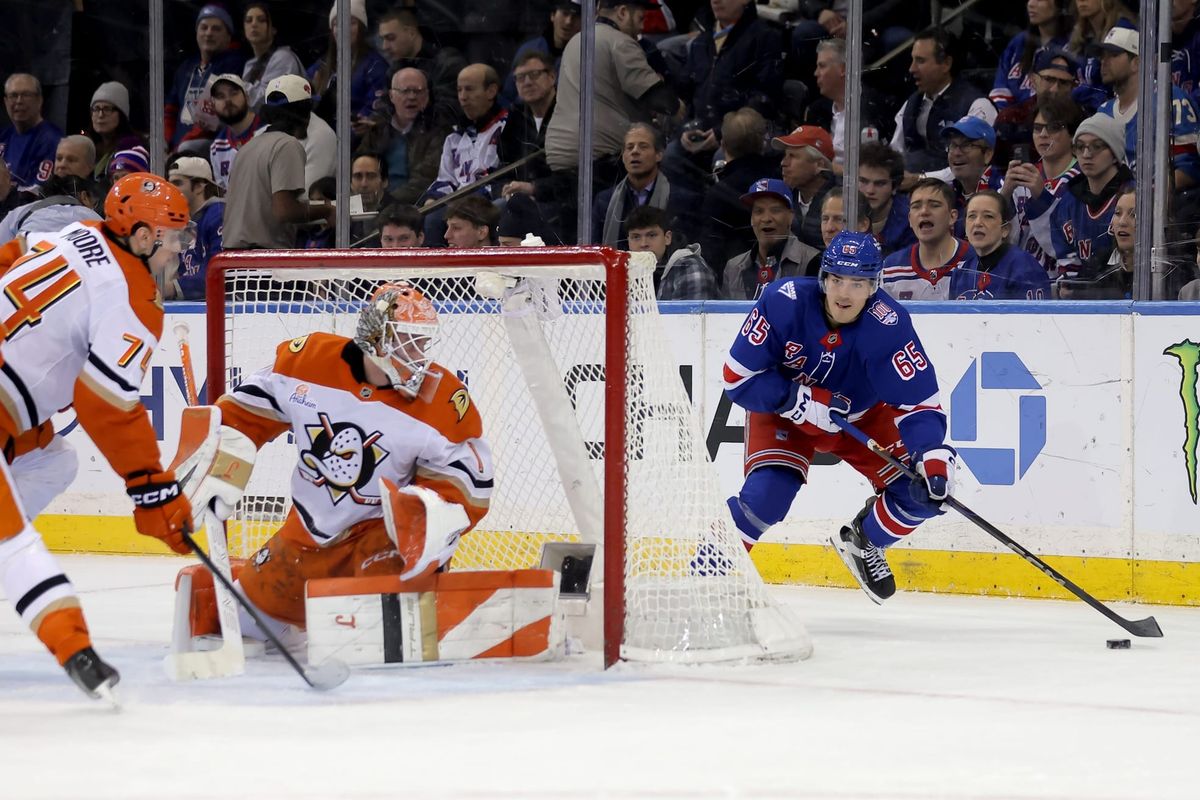
Berard played in a total of four games during that stint, 67 shifts in total, against some real tough customers; outside of a few blocked shots, he did nothing of substance.
What followed was a barrage of recalls and reassignments—a yo-yo act so relentless it deserved its own Cirque du Soleil billing:
- Dec. 17 — Assigned to Hartford Wolf Pack.
- Dec. 22 — Recalled by New York Rangers.
- Dec. 28 — Assigned to Hartford Wolf Pack.
- Jan. 1 — Recalled by New York Rangers.
- Jan. 6 — Assigned to Hartford Wolf Pack.
- Jan. 29 — Recalled by New York Rangers.
- Jan. 31 — Assigned to Hartford Wolf Pack.
- Feb. 17 — Recalled by New York Rangers.
- Feb. 26 — Assigned to Hartford Wolf Pack.
- March 10 — Recalled by New York Rangers.
- March 10 — Assigned to Hartford Wolf Pack.
Six recalls. Zero points. One existential crisis.
To be fair, and I'm straining to find something, like a defense attorney at a sentencing hearing—Berard's non-scoring contributions weren't invisible.
Berard registered 17 hits and 9 blocked shots in those 13 games, solid numbers for a young guy getting barely 10 minutes a night, but his underlying numbers didn't help much. Both his CF% of 44.8 percent and FF% of 46.8 percent confirm Berard was being outshot, and outchanced, at 5-on-5 consistently. His xGF of 4.6 against an xGA of 5.1 produced an E+/- of -0.5 — essentially break-even in expected goal differential, but that's small consolation when the box score reads zero points in 13 games.
In a contract year, where every shift acts as an audition, Berard couldn't get himself off the waitlist and at 5-9 and 174 pounds, a player who isn't producing offensively isn't going to stay in the conversation for long. Even less so, when the team that you play for is now in the midst of a retool, or a rebuild, or whatever term we're hiding our failure behind.
Grade
Author Grade: D
Banter Consensus: D-
Final Evaluation
This hurts to write, as I was one of Brett Berard's loudest advocates.
I built a makeshift statistical monument to his potential and planted a flag on top of it.
And look—I still believe the talent is in there somewhere, I really do.
The speed is real, and his compete level is genuine. But zero points in 13 NHL games is still zero points in 13 NHL games, and, Mike Sullivan has no desire to polish a turd unless that turd is related to him by marriage.
The grade isn't an F because Berard controlled what he could—his effort, physicality, and willingness to simplify his game and embrace a checking role.
Not to mention the fact that he showed maturity in his interviews and resiliency in the face of an existence that would break lesser competitors.
But development isn't linear—sometimes, the leap that you expect a player to make turns into a stumble. In the same season where Brett Berard was supposed to cement himself as a Sullivan-era staple, he became a cautionary tale about projection models meeting reality.
Brett Berard will enter the offseason as an RFA with an uncertain future.
The Rangers will likely tender him a qualifying offer, as the cost is negligible, and the upside is recent enough to justify the bet. However, the window for Berard to establish himself as a New York Ranger is closing, as he'll turn 24 in September.
I hate to admit it, but I got this one wrong.
The kid who wasn't supposed to be here? This year, he mostly wasn't.