2026 Rangers Season Preview: Marcus Pettersson
Brought in to stabilize their defensive depth, it's fair to wonder which version of Marcus Pettersson will the Rangers see?

This article is part of an ongoing series of New York Rangers Season Previews, taking a close look at what we can, and should, expect from each member of the 2026-27 New York Rangers. To read other articles in this series, go here.
A fun little fact about Marcus Pettersson to start: Since being acquired by the New York Rangers for their 2030 first-round pick, he has not only been traded for a first-round pick twice, but has also been traded specifically for a Rangers' first-round pick twice. Back in 2025, the Rangers sent their 2025 first-round pick to the Vancouver Canucks as part of the J.T. Miller trade, and the Canucks wasted no time in flipping that pick to the Pittsburgh Penguins for Pettersson.
It’s not a big surprise that Pettersson found his way to the Rangers. He and Mike Sullivan had a long history in Pittsburgh. After Pettersson agreed to waive his no-movement clause to come to New York, Sullivan has not been shy about heaping praise on the Rangers’ new veteran defenseman.
Sullivan described him with several buzzwords the Rangers sorely need, calling him a puck-moving defenseman who is safe, smart, and consistent. While Pettersson has had productive years, the Rangers are no stranger to swinging a big trade for a marquee defenseman, only to see them show up under the bright lights of Broadway looking like the Walmart-brand version of their former self.
So, the question is: What version of Marcus Pettersson will the Rangers get?
Previous Performance
Let’s start from the top to get this out of the way. Pettersson’s time as a Canuck was not so great, but you’d be hard-pressed to find a single player who had a productive year in Vancouver this past season under one-and-done head coach Adam Foote.
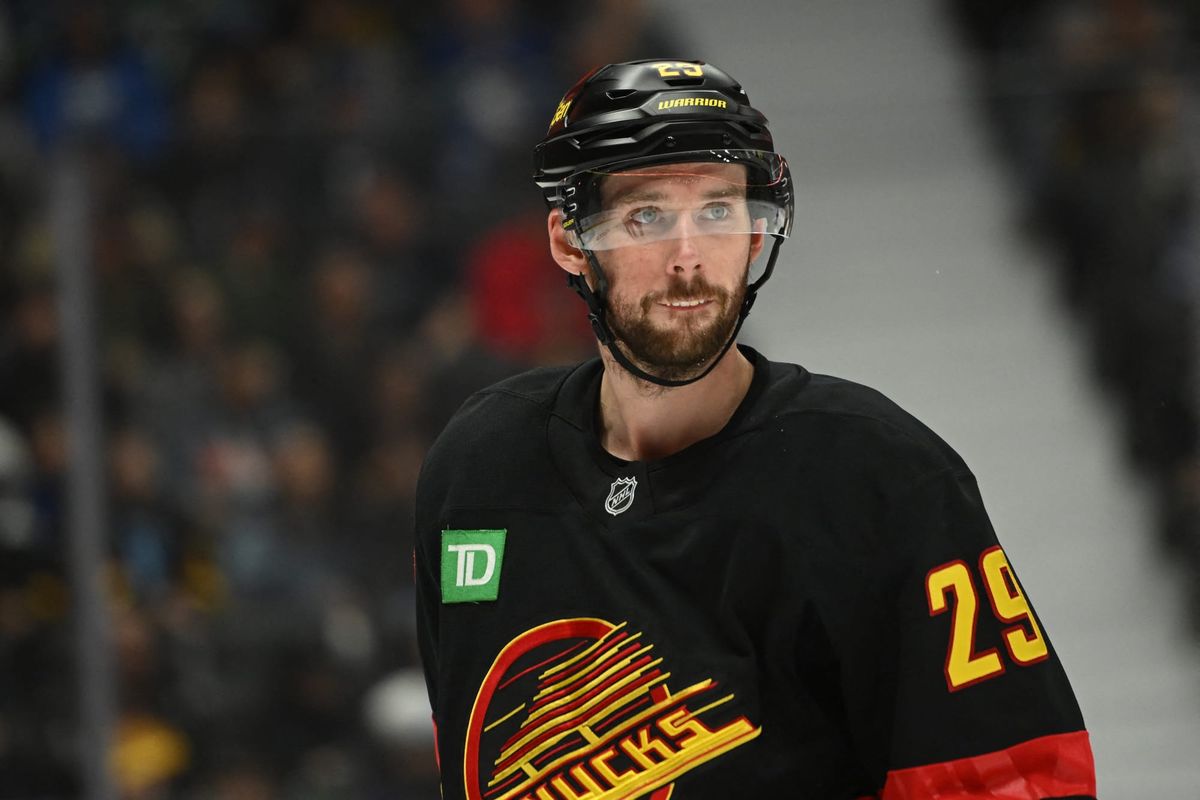
He was heavily relied on for the penalty kill, playing over two and a half shorthanded minutes per game for the Canucks, just behind Tyler Myers for second most on the team. He also averaged over 21 minutes a night for the last-place Canucks. Turning our eyes to his production, Pettersson scored three goals and added 15 assists, but he’s not relied on for his contributions on offense. But, funnily enough, his career best is 30 points when playing for Sullivan on the Penguins.
Before his trade from Pittsburgh, Pettersson’s play, to Sullivan’s credit, can be viewed as safe and consistent. He was never a game-breaking player, but he did come up big on the penalty kill or with a smart defensive play. He has a lot of the qualities the Rangers see in Vladislav Gavrikov: a defensively sound and silent contributor to the success of his team. Looking at his even-strength numbers before his time as a Canuck, Pettersson had never posted below 50.9 CF% while with the Penguins which, given the timeframe he played with Pittsburgh, is remarkable. He was part of a few unsuccessful Penguins squads that were either marred by injury or a downright lack of cohesion.
If it weren't for Marcus Pettersson, this game likely doesn't even get to overtime. 😲
— NHL (@NHL) November 1, 2024
What a play! https://t.co/1XhWhKRVrh pic.twitter.com/uMtV41YwDv
Drafted by the Anaheim Ducks in the second round of the 2014 NHL Draft, Pettersson was breaking into the NHL when Bob Murray, the Ducks’ GM at the time, looked at an excess of left-handed defensemen in the system and decided he could use them to procure more offensive depth. He then facilitated a trade that sent Pettersson to the Penguins for Daniel Sprong. Sprong came into Anaheim and contributed quickly. To Pettersson’s credit, he stuck in Pittsburgh, and his role increased with each passing year. While it may have seemed like Anaheim got the better end of that deal at first, Pettersson’s smooth skating and mobility as a big defender, standing at 6-5, have made him a coveted asset for several NHL teams. Drury doubled down on retooling, and bringing in Pettersson is exactly that.
Expectations
Pettersson will be expected to bring stability to the Rangers’ defensive depth. For some time now, they have been looking for a veteran presence to play a smooth, dependable game behind their top pair, which will consistently feature Adam Fox and Gavrikov. Several players have been plugged into this role and have failed. It is hoped Pettersson’s style of play and skill will finally be the answer the Rangers sorely need.
Rangers add a legit top-four defenseman in Marcus Pettersson. Like this a lot for them pic.twitter.com/h8TodsNqLi
— dom 📈 (@domluszczyszyn) July 1, 2026
It’s also expected that Pettersson will contribute to the penalty kill, effectively replacing Will Borgen’s role there, and hopefully bumping Braden Schneider further down the depth chart in that domain. It could also be anticipated that Pettersson’s role could impact Schneider’s and others’ ice time in general.
It remains to be seen which role will be allotted to which defenseman, but adding another defensively sound, reliable player like Pettersson will give the Rangers more options for who to put on the ice in key moments. Keep in mind this goes both ways. Not only does it lighten Schneider’s overall role and set him up for success by reducing reliance on him in most defensive situations, but it can also reduce Adam Fox’s workload at times. It may allow him more energy to focus on the other end of the ice.
Predictions
84 GP | 3 G | 18 A | 21 PTS
Pettersson will have a bumpy adjustment. It seems impossible for any new defenseman to not experience this in New York City, but the familiarity of Sullivan’s system will be the saving grace for Pettersson. Once he gets some experience with his new defensive partner, likely Sean Durzi, it’s easy to imagine Pettersson sliding into his comfort zone, shutting down the opposition, supporting the team’s breakouts, and strategically activating to pressure other teams.
Pettersson will play close to 20 minutes a game and will have the second most ice time on the penalty kill behind Gavrikov. After playing every game for the Canucks last season, I’m also predicting Pettersson will play in every game this season as well, all 84 of them. While that would be a career-high in games played for any player, I still predict Pettersson will barely breach 20 points.
It'd be shocking if he features at all on any power play unit, and it's hoped that a majority of his starts on the ice will be in the defensive end. Unless we're all surprised with him usurping Gavrikov's spot on the top pair with Fox, Sullivan would be a fool to prioritize Pettersson getting consistent offensive ice time over a superior offensive-minded defenseman. If all goes well, by December Pettersson will rarely be mentioned, and that’s how you know he’s doing his job.
The Bottom Line
Pettersson isn’t a flashy player. He’s a dependable workhorse who will have a greater impact on the defensive side of the ice and has enough soft skills to avoid detracting from his teammates’ offensive efforts.
His presence alone should be an upgrade over the other options the Rangers would have been forced to play. But, at the same time, it also does delay the arrival of the Rangers' next generation of blueliners. It's fair to assume Pettersson is locked into a second-pair role, which if we also assume Schneider takes one of the third-pair slots, only leaves space for one other player, not counting the extra the Rangers will likely carry to watch from the press box.
Pettersson was very much Sullivan’s guy, and it’s not really a secret that Drury targeted him largely because of that. Because the cost to acquire Pettersson was a conditional 2030 draft pick, the pressure of this failing gets pushed to the back burner, which was an interesting move for Drury, as he's leveraging the "far future" in a way we haven't seen before. If this version of the Rangers, or maybe the next, doesn’t figure it out, it’s likely that losing that pick won’t be Drury or Sullivan’s problem.