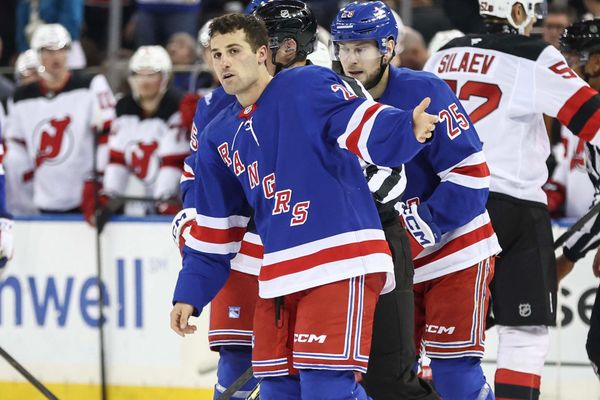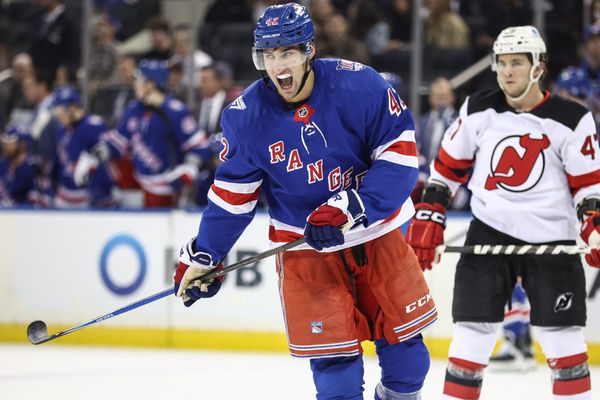
Joe's Reaction of the Week (Snark's Version): Rangers Success Requires Mike Sullivan to Evolve
The Rangers' structure held up last season. Their offense didn't. Can Mike Sullivan evolve his system without abandoning what already works?

Joe is on sabbatical from Joe's Reaction of the Week until November. Until then, other Blueshirt Banter's writers will be filling in for him. Today, it's Snark Messier.
The date is May 15, 2022.
The number one song in the country is Future’s “Wait for U,” featuring Drake and Tems.
The number one movie in the country is Doctor Strange in the Multiverse of Madness, which is pulling in more than $18 million at the domestic box office.
Everyone on social media is dancing to Lizzo’s “About Damn Time,” with more than 800,000 TikTok videos already using the song as its viral dance takes off.
And it is also the date of Mike Sullivan’s last playoff game as a head coach in the National Hockey League.
That night, Sullivan’s Pittsburgh Penguins lost 4-3 in overtime to the New York Rangers in Game 7 of the first round at Madison Square Garden. Pittsburgh had led the series 3-1 before New York completed the comeback on the strength of a clutch overtime goal from former New York Ranger Artemi Panarin.
This will always give me chills. #NYR https://t.co/IWBE3Hl5M9 pic.twitter.com/D3ZnM6dN2L
— Snark Messier (@SnarkMessier) December 12, 2025
More than four years later, Sullivan still has not coached another playoff game.
Pittsburgh certainly did not expect that at the time. Just more than three months after the loss, the Penguins signed Sullivan to a three-year contract extension that was scheduled to keep him behind their bench through the 2026-27 season.
Instead, Pittsburgh missed the postseason in each of his final three years there. Sullivan then came to New York, where his first Rangers team finished 34-39-9 with 77 points, eight fewer than the year before. They scored 235 goals, allowed 249, and finished last in the Eastern Conference.
Four consecutive playoff misses make for an easy narrative, but not an especially accurate one. Sullivan’s first two misses were with teams that continued to control play and remained alive down the stretch.
His final year there looked different, complicated by injuries, roster turnover, and an organization beginning to move in another direction.
Those explanations matter because the argument is not that Sullivan’s system no longer works—his first Rangers season provided evidence that parts of it still do.
The Rangers cannot simply become a cleaner version of last year’s team, though.
They need to preserve the defensive structure Sullivan established while becoming faster with the puck, more capable of sustaining offense, and far less dependent on getting one specific type of game. In an Eastern Conference that improved around them, Sullivan has to evolve the system without abandoning what already works.