The Brady Tkachuk Trade to Florida Was a Blessing for the New York Rangers
The Brady Tkachuk trade saga has come to an end, and not with the power forward landing on Broadway. That's a good thing.

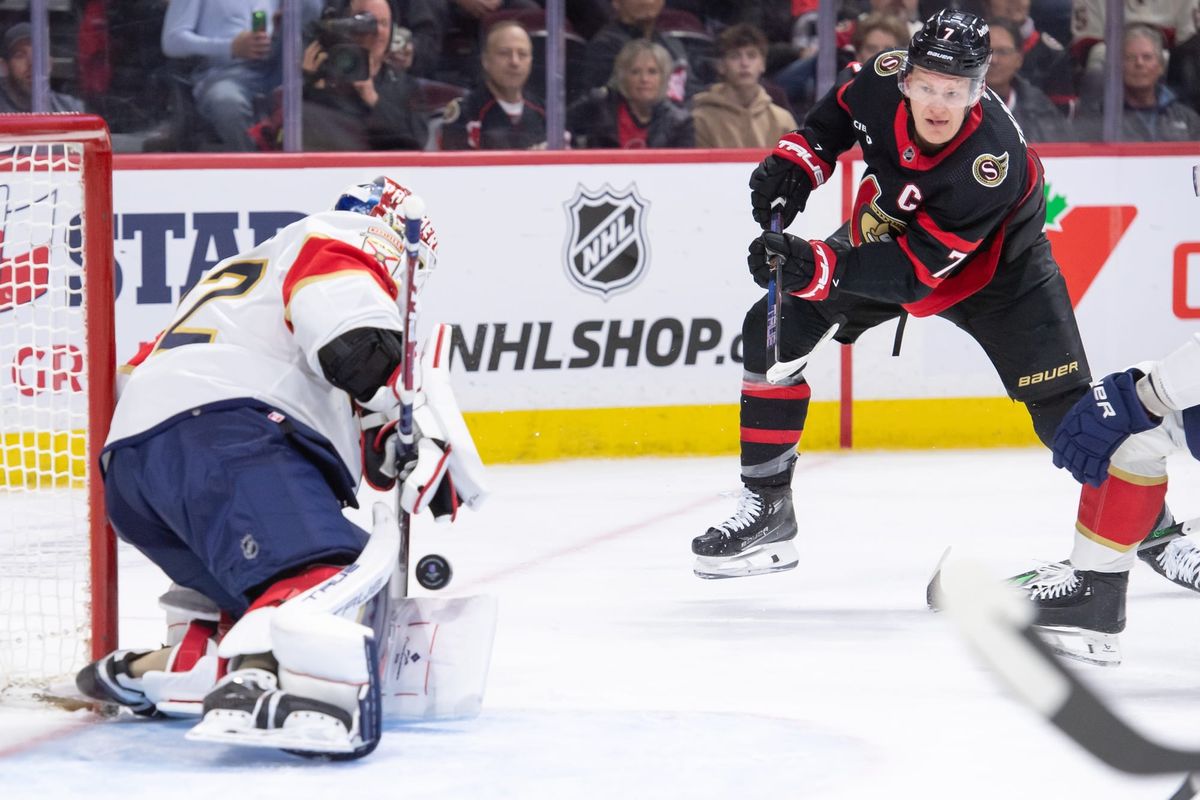
Late on the evening of Fathers Day, a blockbuster hockey trade broke. Despite the captain of the Ottawa Senators previously claiming trade rumors to be just “noise” and emphasizing his commitment to Ottawa, Brady Tkachuk did indeed request a trade and is now officially a Florida Panther. The youngest Tkachuk joins his big brother Matthew with the recent repeat Stanley Cup champions.
There’s no question that this is not only one of the biggest hockey stories to unfold in recent history, but it raises whole slate of fascinating questions about the future of the National Hockey League. All sorts of buzz words like superteams, trade protection, tax free, and even nationalism are flying around in the wake of this news.
Please do not call these NHL teams super teams. The guys teaming up do not want the pressure of living up to that name. They want to be paid big league money while getting beer league attention with house league responsibility https://t.co/PgKaJ71wq2
— Jeff Veillette (@JeffVeillette) June 21, 2026
With Brady now in the mix, the Panthers have the chance to be the first real super team since the 2002-03 Detroit Red Wings and the first of the salary cap era. Right now, their opening night roster looks to feature:
Verhaege - Barkov - Reinhart
Tkachuk - Bennett - Tkachuk
Luostarinen - Lundell - Marchand
Gadjovich - Rodrigues - Boqvist
That’s an insane top nine forward group. Beyond that, you have the trade protection part of the conversation. Should so many players be allowed to have trade protection? Is it fair that they essentially get to dictate where they go, resulting in the team not being able to get a “fair” return for the player? While you could make the argument that these things should be limited, there is a more clear solution: stop giving them out like they're candy.
The NHL is becoming like NBA where top players are dictating where they want to play, often with time left on their contracts. But this is also the team’s fault. They give out no trade clauses at drop of hat now. Stop. Then if player wants out, trade him where best deal is
— Jim Matheson (@jimmathesonnhl) June 22, 2026
Or, instead of worrying about players wanting out, find ways to make them want to stick with your team.
People are asking the wrong questions regarding the NHL’s no-trade/super team crisis. It’s not about how the league can limit the power of players to demand trades. The question should be, “how do we incentivize players to want to stay with their teams?”
— Adam Herman (@AdamZHerman) June 22, 2026
Then of course there’s the palm trees and tax-free side of the conversation that suggest teams in the south like Florida and Tampa have an unfair advantage with the player’s not having to pay state income taxes. While there is certainly an advantage there, it's not as big of one as many make it out to be, especially with the salary cap now rising. And that's not to mention, there is always going to be an opposite side to that coin, as we just saw with Darren Raddysh.
Darren Raddysh leaves a warm weather, no state tax market where he had Nikita Kucherov passing him the puck on the PP to return to his hometown of Toronto to play for the Maple Leafs for less than many projected he would get on the open market.
— Dave McCarthy (@DaveAMcCarthy) June 19, 2026
Lastly, with this coming so shortly after Dylan Larkin requested a trade out of Detroit, you have the Team USA angle, where everyone who was a part of the team that won the gold medal in Milan wants to go play together. For as problematic as that can be, it's not as dire of a matter as this is being made out to be, either. The saying "winning solves everything" is thrown around a lot, but it's true. If Team USA came out of the Olympics with a bronze medal or no medal at all, do we really think guys like Brady Tkachuk or Connor Hellebuyck are champing at the bit to ditch their teams and the Great White North for contenders in the States? Maybe, maybe not. But I can tell you one thing: If Detroit made the playoffs and if Ottawa won a round or two, I'd be willing to bet Larkin and Tkachuk remain with their teams next season.
Now let’s talk about the actual trade itself. It was reported that Brady gave Ottawa a list of four teams to work with: the Vegas Golden Knights, Carolina Hurricanes, Florida Panthers, and Minnesota Wild. What do all four of those teams have in common? Winning. The 2023, 2024, 2025, and 2026 Stanley Cup Championships belong to Vegas, Florida twice, and now Carolina. As for Minnesota, there’s the obvious Team USA connection with Matt Boldy, Quinn Hughes, and Brock Faber all there, not to mention Team USA general manager Bill Guerin. While that's a big part of it, the Wild aren't far off from being a top team in the West themselves.
As much as Florida may have seemed like the obvious destination, it’s pretty clear that neither Vegas or Minnesota really had all that much to offer. We've talked about Minnesota barely having an enticing enough offer for Vincent Trocheck, let alone a player with brand name appeal like Brady Tkachuk. The same goes for Vegas, who doesn’t have any prospects of value or a first round pick until 2028. That left Carolina and Florida, and while it was reported that Carolina put a significant offer out there, their only first round pick in the upcoming draft is 31st overall. And that's not to mentionthat they are expected to be contenders for the foreseeable future, with or without Brady.
That just left Florida, which made all the sense in the world. Why wouldn’t Brady want to play with his brother? And the fact that they had an injury-ridden season that saw them miss the playoffs and land a high draft pick (ninth overall) made this trade make all the more sense. In return, Ottawa gets a top ten pick in this year’s draft, as well as the 25th overall pick, acquired over the weekend by Florida as part of the Mackie Samoskevic trade. On top of that, they get a 2029 conditional first rounder that is top-ten protected, as well as a 2027 second rounder. That’s a risky return for Ottawa considering all the assets are essentially lottery tickets, but in terms of draft capital, it was likely the best they were going to get.
So, what does any of this have to do with the Rangers?