2026 Elimination Eval: Anaheim Ducks
After seven consecutive seasons of missing the playoffs, the Ducks got back to the postseason this year and made quite the impression, coming within two wins of the Conference Final.

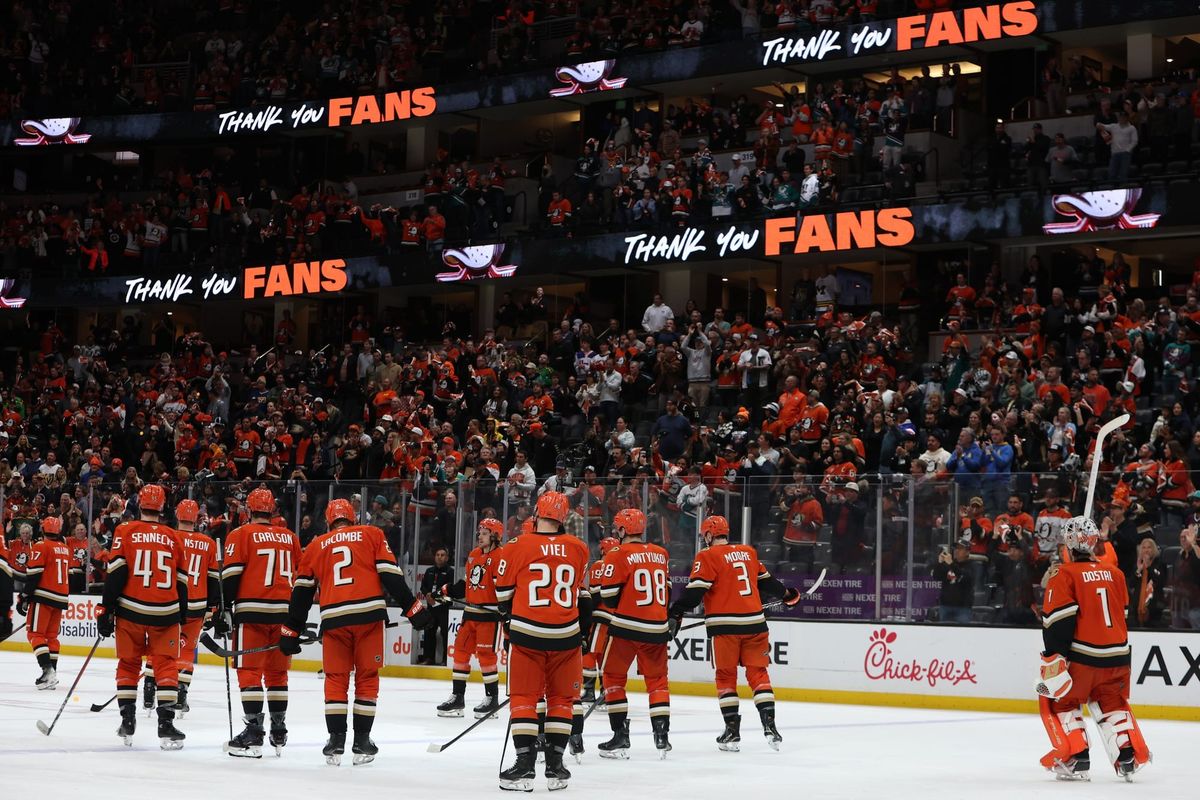
Next season will mark twenty years since the Anaheim Ducks last won the Stanley Cup. A lot has changed since the days of Ryan Getzlaf, Corey Perry, and Bobby Ryan, but the Ducks have powered through the rebuild process and are finally seeing those efforts pay off for them as their young core led them successfully into the second round in a playoff run they can look back on and be proud of.
Expectations
The Ducks finished last season with 80 points, which left them quite far from the playoff picture and just ahead of the Seattle Kraken and San Jose Sharks, who finished below them in the Pacific Division. They were slowly beginning to show signs of a team taking those next steps. They made the big move to acquire Chris Kreider for pennies on the dollar and kicked off free agency by inking Mikael Granlund to a three-year deal. Beyond that, they really didn’t do much else on the open market, aside from finding a diamond in the rough of sorts in Tim Washe.
Anaheim’s offseason priority was getting some big name RFAs signed to new deals, namely Jackson LaCombe, Mason McTavish, and Lukas Dostal. Goaltending was the first piece of the puzzle to fall into place. They traded John Gibson to Detroit and signed Dostal to a five-year, $6.5 million AAV deal, making him their established number one goaltender. Once the dust settled there, they signed LaCombe to a massive eight-year, $9 million AAV deal and eventually got McTavish under contract on a more significant deal than many probably expected (six-years, $7 million AAV).
It was on the trade front where the Ducks really made significant moves. They picked up Jeffrey Viel for a fourth round pick back in January, which ended up being a really good move for them as the season progressed. At the trade deadline, they were pretty quiet aside from sending Ryan Strome to Calgary. But in the eleventh hour, they acquired long time Washington Capitals defenseman John Carlson for a first and a third round pick. That really rounded their defense out well, as they had an experienced and difficult to play against right side with some young and talented players on the left.
Series Recap
The Ducks got off to a rough start on the road but quickly rebounded to win three in a row. They trailed Game 1 of the opening round after giving up a pair of goals in the final three minutes of the first period in Edmonton. However, a strong second period, including a pair of goals from Troy Terry and another from Leo Carlsson, gave the Ducks a 3-2 lead heading into the third. Kasperi Kapanen would secure the game-winner with less than two minutes to go, but the Ducks were motivated to respond.
And not only would the Ducks respond, but they would learn to deal with adversity, as the Oilers would score first in both Game 2 and Game 3. Cutter Gauthier and Ryan Poehling each had a pair as Jacob Trouba and Alex Killorn added to the scoresheet to secure a 6-4 win in Game 2. It would be the same final score in Game 3, as Beckett Sennecke, Jeffrey Viel, and Jackson Lacombe all picked up their first career playoff goals in the third period to come back from a 3-2 deficit.
Game 4 was, of course, the most talked about game of this series, as the Ducks battled back from a 2-0 first period deficit. A third period goal from Viel forced the game to overtime. Ryan Poehling’s game-winner would be controversial as the puck definitely maybe crossed the goal line to secure the win and give the Ducks a 3-1 series lead.
The Oilers responded accordingly with a 4-1 win in Game 5, but the Ducks took care of business in Game 6. Three goals from Poehling, Gauthier, and Chris Kreider gave the Ducks a 3-1 lead heading into the second period. Troy Terry extended that lead late in the second period, and an empty netter from Carlsson finalized a 5-2 win to punch Anaheim’s ticket to the Conference Semifinals. This was undoubtedly the high moment for the Ducks as it was their first playoff series win since 2017, as they sent the two-time defending Western Conference champions packing.
The Ducks got lucky with the good goal call in OT of Game 4 against the Oilers, but they’d have no such luck in Game 1 in Vegas. After Mikael Granlund tied the game in the third period, Ivan Barbashev scored on a goal that almost certainly shouldn’t have happened. Just prior to the play unfolding, Barbashev dumped the puck in well before reaching the red line, which should have resulted in an icing call. Instead, the officials waved it off. Pavel Dorofeyev set up Barbashev for the go-ahead tally, and the Golden Knights went on to win Game 1 by a score of 3-1.
Once again, Anaheim responded well and found the back of the net midway through the second to take a 1-0 lead in Game 2. Goals from Carlsson and Jansen Harkins extended the lead to 3-0, with the latter coming on an empty net. Lukas Dostal was six seconds away from a shutout when Mark Stone found the back of the net on the power play, but the series was now tied at one game a piece.
Aside from the obvious Game 6 that ended their season, there really wasn’t a clear low moment for Anaheim. But Game 3 was probably as close to one as you’ll find. It was a rough night for Dostal who gave up five consecutive Golden Knights goals, including a hat-trick from Mitch Marner. The Ducks found some life in the third as goals from Sennecke and Kreider got them on the board, but an empty netter from Brett Howden secured a 6-2 victory.
Game 4 proved that Anaheim wasn’t going to go down without a fight. A power play goal from Beckett Sennecke got them on the board, and even though Vegas was quick to answer, the Ducks continued to hold their own. A power play goal from Alex Killorn gave them the lead late in the second period, and Ian Moore’s first career playoff goal gave them an insurance lead. Tomas Hertl brought Vegas within one with a minute to go, but the Ducks held on and tied the series up at two with a 4-3 win.
Game 5 was the game-changing moment of the series with the tide turning against the Ducks. The importance of a Game 5 in any series that’s tied two wins apiece is obvious, and with it coming down to overtime showed just how close it was to being anyone’s series. Sennecke opened the scoring again and Olen Zellweger would tie it with just over three minutes to go in regulation. It was a huge momentum shifter for the Ducks. But it was Pavel Dorofeyev who was the hero in overtime. The Ducks outshot Vegas, stayed out of the penalty box, and did all the right things to stay in this game, but they just couldn’t get it done in extras.
Dorofeyev would continue to be the difference maker in Game 6, as his pair of goals in the third period put a pretty contest out of reach for Anaheim. But it was Mitch Marner’s entry best goal of the playoffs that put Vegas on the board just 62 seconds into play.
Granlund had the lone goal for the Ducks in the second period on the power play in the 5-1 loss. Coming off the loss in Game 5, the Ducks also lost a key part of their team in Ryan Poehling, who suffered in injury following a hit that earned Brayden McNabb a one game suspension. That certainly didn’t help their cause, as Anaheim’s season came to an end in Game 6.
Prediction
Perhaps we’re all just cynical Rangers fans rooting for Edmonton’s downfall in hopes that Connor McDavid will come save us, but four of the five of us who participated in the roundtable we did at the start of the playoffs had the Ducks advancing to the second round. For as much as many of us were surely rooting for the Ducks to upset Vegas, it was all but expected for them get bounced in the Conference Semifinal. They fought hard and were a fun team to watch this season, but when push came to shove, experience came out on top.
Was the Season a Success?
Without question this season was a success in Anaheim. Even if you were optimistic about this team taking a step forward this season and went as far as saying they could be in the wild card conversation, expecting them to make it to the Conference Semifinals and give a team like the Vegas Golden Knights a run for their money was exceeding expectations.
The Ducks should be proud of what they accomplished this season, getting back to the postseason for the first time since 2018. The big test from here will be whether or not they can build from this and remain a part of the playoff picture in the Western Conference.
UFAs/RFAs
Of all the teams who have been eliminated from the playoffs thus far, the Ducks might have the most work cut out for them this summer. Practically their entire blue line is in need of new contracts, as Jacob Trouba, Radko Gudas, John Carlson are all pending UFAs, and Ian Moore, Pavel Mintyukov, Olen Zellweger, and Tyson Hinds are pending RFAs. In addition, the majority of those bottom-six forwards who stepped up for them in the postseason—Jeffrey Viel, Ross Johnston, and Jansen Harkins—are pending UFAs. And, most notably, two of their young forwards who are expected to be important parts of this core long-term are set to become RFA’s: Cutter Gauthier and Leo Carlsson.
While it’s a bit unclear what their plan is on the blue line, you have to imagine the priority will be getting Gauthier and Carlsson signed to long term deals. Pavel Mintyukov and Owen Zellweger will be interesting names to keep to keep an eye on, too. Mintyukov’s name was being floated around in trade rumors last season, but as the year went on, he was playing over Zellweger. You'd have to think, in an ideal world, both would remain with the team, as Mintyukov can probably play the right side. But with lots of RFA business to tend to and only so much money to go around, one of the two could end up on the trade block.
Biggest Question Moving Forward
The Ducks have a couple of big questions as they move on from this season. The first centers around their blue line. Do they keep any of Gudas, Trouba, or Carlson? Ian Moore and Drew Helleson are likely fine to slot in on the second and third pairings, but unless you’re going to try and target a bigger fish, it’s probably in their best interest to keep at least one of those three names around for the next several seasons.
Beyond that, Mason McTavish is a name that is going to pop up a lot this summer, specifically as a potential trade target for the New York Rangers. This is a young center (a former third overall draft pick) who was not only healthy scratched in Game 2 of the Vegas series, but spent time in the press box throughout the season. It's never a good look but when you’re scratching a player of McTavish’s caliber to get guys like Ross Johnston and Jeffrey Viel more minutes, and you have to think it’s only a matter of time before a change of scenery takes place. As things stand, McTavish is likely stuck on the third line with both Carlsson and Granlund ahead of him in the depth charts. While Anaheim is surely fine with that, you'd have to imagine McTavish would like to be in a situation where he'd see more playing time.
Roster construction aside, the main question is going to be associated with how the Ducks look to repeat the success they've had this season and potentially take it a step further. The pieces are there, but there is still going to be important work to be done if they want to hang with a stacked Western Conference moving forward.
Projected Lineup
Kreider - Carlsson* - Terry
Gauthier - Granlund - Sennecke
Killorn - McTavish - Vatrano
Poehling - Washe - ?? - ?
LaCombe - ?
Mintyukov* - Helleson
Zellweger - Moore*
Hinds*
Dostal - Husso
Next in line:
- Forwards: Roger McQueen, Nathan Gaucher
- Defenseman: Tristan Luneau, Noah Warren, Stian Solberg
- Goalies: Damian Clara
(*-RFAs) (^-UFAs)
Final Thoughts
Carlsson, Gauthier, Sennecke, LaCombe, and Dostal is a pretty solid core to build around. The Ducks are going to be an interesting team, as they’re divided between aging veterans and young stars on the brink of their prime. Finding that balance is going to be a key objective for them moving forward and you do have to wonder if Joel Quenneville is a coach capable of that. When push comes to shove, he's the type of old school coach that is always going to give preference to veterans and as we saw in these playoffs, gritty depth players over younger skilled players.
There's no end-all-be-all recipe for success but for a team like Anaheim, you have to let the youth pave the way here.