2026 Elimination Eval: Minnesota Wild
For the first time in 10 years, the Minnesota Wild got past the first round of the Stanley Cup Playoffs. But a second round match-up with the Colorado Avalanche sent them packing.

Minnesota is the State of Hockey. In many ways, it’s a shame that the North Stars had to relocate to Dallas, and even more unfortunate for the fans as, just a couple of years later, that franchise won a Stanley Cup as the Dallas Stars.
Well, they got revenge in a very minor form this year as the Minnesota Wild secured their first round one playoff series victory in a decade against those very Dallas Stars. In a year that brought the Wild a top-of-the-league defenseman, a pair of strong starting goaltenders, and an incredibly well-rounded roster in nearly every position (except a very important one), there was a thought this could be their year.
As it turned out, Bill Guerin still has plenty of work ahead of him.
Expectations
Minnesota has made the playoffs in five of the last six seasons and has only missed the postseason twice in the last thirteen seasons. While that in itself is a good thing, the fact that the only playoff success they have to show for is a single first round victory is a tough look. In their entire history as a franchise, the Wild have only gotten as far as the Western Conference Final once, and that was in just their third season back in 2003. They are long overdue for playoff success, and taking a step in the right direction was a big part of their expectations for this season.
Free agency was a bit slow in Minnesota, given the fact that Guerin had three big name RFAs in need of new contracts, most notably Kirill Kaprizov. Knowing he certainly wouldn't want to pay open market prices on July 1, the only signings he really made were Nico Sturm on a $2 million, two-year deal, and former friends Tyler Pitlick and Nicolas Aube-Kubel on cheaper two-way deals. The Wild did take advantage of a situation in Detroit, as they acquired Vladimir Tarasenko for future considerations. But aside from that, the focus was on their RFAs.
After getting Marco Rossi signed to a three-year deal, they made Kaprizov the highest paid forward in the NHL with an eight-year deal that carries an AAV of $17 million. With just enough cap space to sign goaltender Filip Gustavsson to a five-year extension carrying an AAV of $6.8 million, the Wild were ready to head into the season. But the work was just beginning.
The Quinn Hughes trade will be the type of blockbuster trade hockey fans remember for years to come. Sending Zeev Buium, Liam Ohgren, Rossi, and a first round pick to Vancouver, the Wild acquired a definitive top-five defenseman in the league. That’s good business for any team, but the Wild already having a budding star of their own on the blue line in Brock Faber only made it better.
The bulk of Guerin’s preparations for this playoff run came at the trade deadline. In a total of five deals, the Wild acquired Michael McCarron, Nick Foligno, Bobby Brink, Jeff Petry, and future considerations, giving up a second and seventh round pick, Davis Jiricek, Vinnie Hinostroza, as well as more future considerations. While the value of some of the individual trades was a bit questionable, all five deals, in a vacuum, were helpful for a team looking to go on a deep playoff run.
Series Recap
Drawing the Dallas Stars as a first round opponent is far from an ideal situation, but the Wild got off to the great start with a dominant 6-1 showing in Game 1. A power play goal from Joel Eriksson-Ek got them going in the first five minutes of play and three unanswered goals from Kaprizov, Ryan Hartman, and Matt Boldy helped put things out of reach. However, it didn’t take much for the Stars to bounce back, as their power play helped them come out of Game 2 and Game 3 with a pair of wins. Game 4 was the game-changing moment of the series as the teams headed to overtime with the score tied at two, and Matt Boldy secured a much-needed Game 4 win for the Wild.
That was the beginning of the end for the Stars’ postseason, as the Wild won Game 5 by a score of 4-2, and then a pair of goals from Hughes and Boldy secured a 5-2 win in Game 6. Advancing to the Western Conference Semifinal, the Wild would have their work cut out for them with the Colorado Avalanche.
Game 1 of round 2 was quite the goalscoringpalooza, as the teams potted a total of 15 goals across sixty minutes. After three unanswered goals from Colorado, Marcus Johansson and Ryan Hartman brought the Wild within one. Nick Blankenburg opened the scoring for the Avalanche in the second, but three unanswered from Minnesota gave them a brief lead. It was all Colorado in the third, as they picked up four more goals to take a series lead with a 9-6 win. Despite making 34 saves, Wallstedt allowed a total of eight goal,s which would be enough for the Wild to make a change in Game 2.
With Filip Gustavsson getting his first start of the playoffs, the Wild were hoping for a momentum shift, but instead Colorado took advantage of the change. Martin Necas scored just three minutes into the game, and even though Kaprizov was quick to answer, Minnesota would not lead again for the rest of the night. An early second period goal from Nicolas Roy extended the lead and a power play goal from Nathan MacKinnon put things out of reach. In the end, there was some logic to giving Gustavsson the start here, but in hindsight, it might have been an overthought decision.
Game 3 would be the lone high moment of the second round for the Wild, as back-to-back goals late in the third gave them a 2-0 lead, and an early second period power play goal from Hartman gave them insurance. While MacKinnon converted on a power play midway through the second, a quick answer from Faber regained their confidence and led them to a 5-1 win. Wallstedt had a nice bounce back with a 35 save outing, holding the Avalanche to just the one goal.
Game 4 would be the low point for Minnesota. Danila Yurov opened the scoring on the power play midway through the first to give the Wild the lead. Wallstedt was strong all throughout the outing, posting a .906 save percentage, but it wouldn’t be enough. Goals from Nazem Kadri and Ross Colton put Colorado in front, and despite a goal from Nico Sturm to tie it up in the third, Parker Kelly picked a good time for his first of the post season. A pair of empty netters pushed the series to the brink with a 5-2 Minnesota loss.
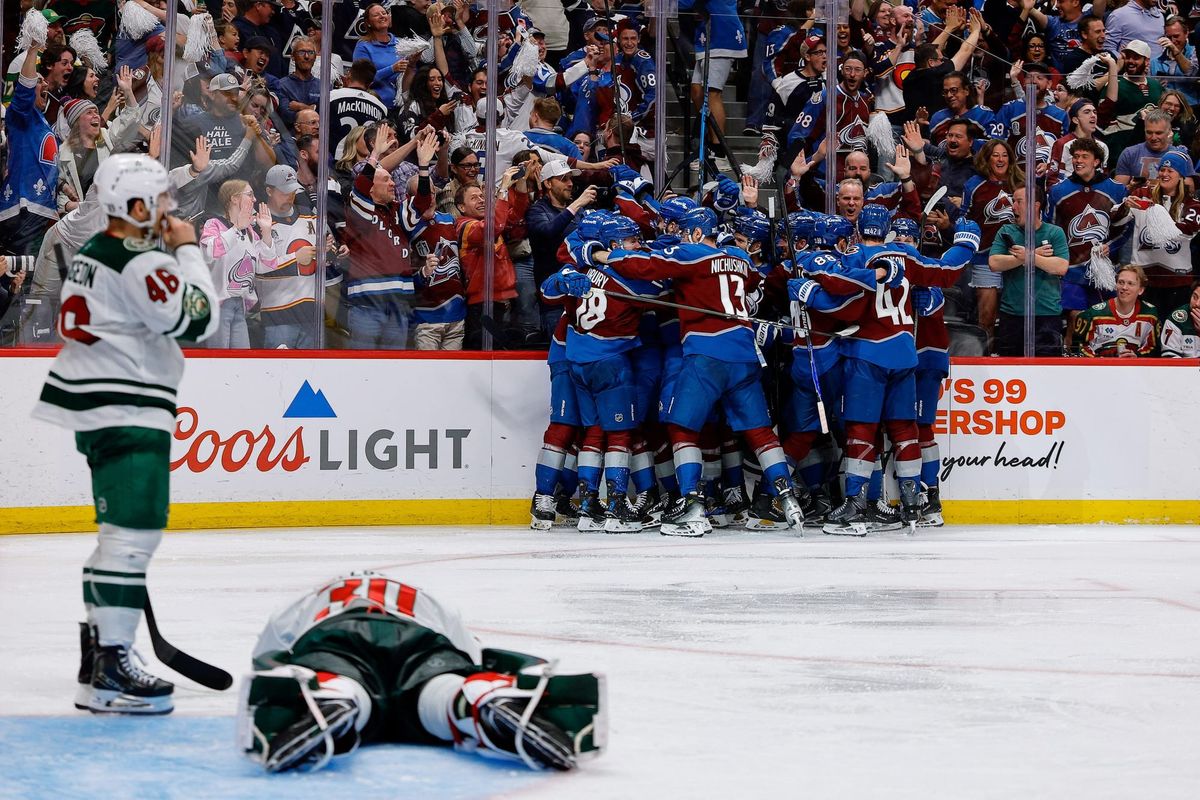
Unfortunately for Minnesota, things got much worse in Game 5. But it didn’t seem that way at the start. Three unanswered goals, including one from Johansson just 34 seconds in, gave them a 3-0 lead heading into the first intermission. Parker Kelly got Colorado on the board in the second period, and Jack Drury brought them to within one late in the third. The Wild were less than a minute and a half away from winning this one when MacKinnon absolutely sniped the game-tying goal with 83 seconds to go in regulation from the exact spot where he missed the net in the Olympics gold medal game. Four minutes into overtime, it was Brett Kulak picking up his first of the playoffs to put an end to Minnesota’s season.
Prediction
Despite how good the Wild were, Dallas was still considered such favorite in the first round that Eric was the only one of us who predicted the Wild would get this far. Regardless of where you had the Wild going in your bracket, predicting them to go all the way to the Cup final in a journey that would include the Stars, Colorado, and whichever team on the other side of the West bracket got to the Conference Final, would be quite the long shot—one that has more to do with their opponents than it does the quality of team Minnesota has. Even if they had managed to come back and beat the Avalanche, this is a team that would have been crawling to the Cup final having taken down some of the top teams in the league in the process. With the Carolina Hurricanes the favorites to come out of the East, that’s would have been asking a lot from a team that’s would have been put through the ringer such as this one.
Was the Season a Success?
It’s not going to feel like this season was a success initially, but this is the furthest the Wild have gotten in the postseason in 15 years. I’d say that, at bare minimum, is a successful step in the right direction. Granted, when you manage to pull off a blockbuster trade to acquire one of the top five defensemen in the league who is on a timeline from a contract perspective, you elevate your standards.
At the same time, it takes a lot for a team that hasn’t had a ton of playoff success to go on a magical run out of nowhere. It’s even more difficult to do in the stronger conference and the toughest division in hockey. This season in a vacuum was a success, and you could certainly say Minnesota hit their goal to take those next steps, but the expectations are only going to increase going into next season.
UFAs/RFAs
Bill Guerin is going to have plenty of decisions to make this summer, specifically with UFAs. Mats Zuccarello, Vladislav Tarasenko, and Marcus Johansson are among the more significant parts of the team at risk of hitting the open market on July 1. Beyond them, there’s recent trade deadline acquisitions Nick Foligno, Michael McCarron, Jeff Petry, as well as Zach Bogosian, and Robby Fabbri. On the RFA front, it’s just Bobby Brink and Daemon Hunt, who I’m sure will both be extended on respectable deals.
I’d love to see Zuccarello hit free agency and perhaps even return to New York to finish out his career. But if he firmly believes Minnesota is on the brink of something special, I’d imagine he’d be willing to stick around on another team-friendly, bonus-heavy deal. His chemistry with Kaprizov being a key factor in that. Tarasenko will probably test the open market again. Nick Foligno could stick around if Guerin is interested in keeping him and at that point, you might as well see if you can extend McCarron, as that Foligno-McCarron-Foligno fourth line is just an absolute force to go up against on any given night. The biggest challenge in making these decisions will be finding that balance of keeping this group together but not remaining stagnant.
Biggest Question Moving Forward
I’d say Minnesota has two obvious questions moving forward.
The first is in net, as I just don’t see either Jesper Wallstedt or Filip Gustavsson being interested in splitting the workload at this point in their careers. Gustavsson just signed a notable (and expensive) five-year extension at the start of this season with loads of trade protection. Wallstedt is still under contract on a bridge deal through 2027, but has done everything to prove himself as Minnesota’s number one goaltender (Also, "The Wall of St. Paul" is just an unreal nickname). I’m not sure how you justify paying a backup goaltender north of $6 million, but the trade protection you gave him prohibits a trade outside his approval. Do you just find a way to move him and get that cap hit off the books? Or do you attempt balance the time for what would surely be the best goaltending duo in the entire league?
As for the other big question mark: I don’t care how great your defense core is, how good your wing depth is, how solid your goaltending is. This team needs to improve their center depth in a serious way. Joel Eriksson-Ek is, in many ways, extremely underrated (when healthy). But when Ryan Hartman is your first line center and the only thing separating him from McCarron is Yurov, you have to figure something out.
Should they have traded for Vincent Trocheck? Probably. Does it help the Rangers case that they didn’t? Absolutely. The only way Chris Drury entertains a Trocheck deal now is if Yurov is included. But even if that were the case, I’m still unsure a top six with Eriksson-Ek and Trocheck down the middle is the most effective course of action.
Projected Lineup
Kaprizov - Hartman - Zuccarello^
? - Yurov - Boldy
M. Foligno - ? - Brink
Trenin - Sturm - ?
? - ?
Hughes - Faber
Brodin - Spurgeon
Hunt* - Middleton
Kierstad
Wallstedt - Gustavsson
Next in line:
- Forwards: Charlie Stramel, Riley Heidt, Hunter Haight
- Defenseman: Viking Gustafsson-Nyberg, Ben Dexheimer
(*-RFAs) (^-UFAs)
Final Thoughts
Any doubts you have about Minnesota can be reassured by four names: Kirill Kaprizov, Matt Boldy, Brock Faber, Quinn Hughes. That’s a remarkable core to build around.
They have to find a way to improve their center depth, and with consideration to the wear and tear on Jared Spurgeon and Jonas Brodin, you do have to start asking questions about their defense. At the same time, they have what I would argue is the best defense pairing in the entire league in Hughes and Faber.
As long as they can make the right decisions to fill in the gaps in their lineup, they should be more than capable of getting back to the playoffs, potentially further than the second round.