2026 Rangers Season Previews: Noah Laba
Noah Laba proved as a rookie that he belongs in the NHL. Now the Rangers need to find out if he can add enough offense to anchor their third line long-term.
A year ago, Noah Laba had never played an NHL game.
By the end of the 2025-26 season, he had played 74 of them.
More importantly, he had done enough in those 74 games to change the conversation surrounding him. Laba is no longer a prospect trying to prove he belongs in the NHL. He’s a Ranger trying to determine how large of a role he can handle.
I fucking love Noah Laba. #NYR pic.twitter.com/x1tfiQzsYl
— Snark Messier (@SnarkMessier) October 12, 2025
That distinction matters.
The defensive side of his game translated almost immediately. The offensive side remains a work in progress, and his 5v5 numbers left plenty of room for improvement. But for a 2022 fourth round pick who entered last season with zero NHL experience, simply establishing himself as a legitimate NHL center was a pretty successful first act.
Now comes the more interesting part.
With the 2026-27 season approaching, can Laba build enough offense around an already promising defensive foundation to become a legitimate long-term piece down the middle?
Previous Performance
Laba arrived in the NHL with a reputation as a two-way center, and there was plenty of evidence behind it.
Across three seasons at Colorado College, he recorded 41 goals and 85 points in 100 games. His sophomore season was particularly impressive, as Laba led the Tigers with 20 goals and 37 points while earning NCHC Defensive Player of the Year honors and Second Team All-American recognition. He followed that by winning 57.3 percent of his faceoffs during his final collegiate season.
The Rangers got their first look at how that skill set would translate to the NHL in 2025-26.
Laba finished his rookie season with nine goals, 15 assists, and 24 points in 74 games while averaging 13:28 of ice time. He put 73 shots on goal, won 50.8 percent of his faceoffs, recorded 110 hits, and blocked 43 shots.
The raw scoring numbers weren’t particularly eye-popping.
The defensive results were.
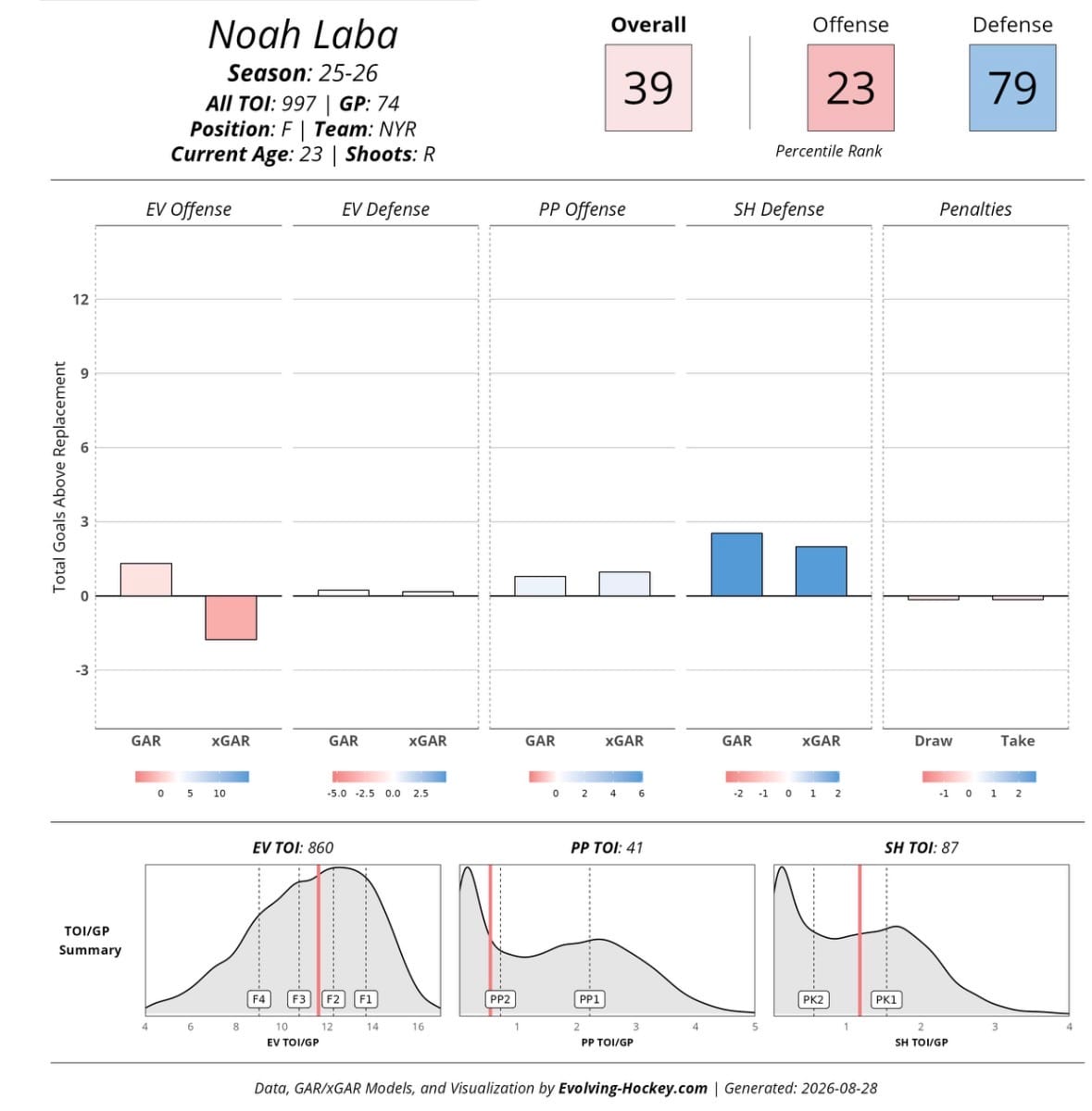
Laba’s Player Card from Evolving Hockey placed him in the 39th percentile overall and just the 23rd percentile offensively, but in the 79th percentile defensively. His shorthanded defense was an obvious strength on the card, with both his actual and expected Goals Above Replacement comfortably above zero.
HockeyStatCards tells essentially the same story from a different model. Laba finished in the 65th percentile defensively, but only the 12th percentile offensively, with his Net Rating landing in the 19th percentile.
So, the analytics community appears to have reached a consensus. Defense? Absolutely. Offense? Not that bad, once you add some much-needed context.
At 5v5, the Rangers controlled only 45.9 percent of the shot attempts and 45.5 percent of the expected goals with Laba on the ice. His scoring-chance share was better at 48.2 percent, while New York controlled 47.2 percent of the high-danger chances. Despite those underlying numbers, the Rangers actually outscored opponents 29-26 during Laba’s 5v5 minutes.
That positive goal differential came with New York shooting 9.6 percent and receiving a .931 save percentage with Laba on the ice, producing a 1.027 PDO. That doesn’t invalidate the actual results, but it does suggest the Rangers probably shouldn’t expect to continue winning Laba’s minutes while getting outplayed to the same degree underneath them.
His deployment wasn’t entirely friendly, either. Laba took 238 defensive-zone faceoffs compared with 188 in the offensive zone, and he had more defensive-zone starts than offensive-zone starts.
Then there were the linemates.
Natural Stat Trick tracked Laba on 34 different three-forward combinations at five-on-five. His most frequently used line—Conor Sheary, Laba, and Tye Kartye—played only 80:37 together across nine games. That trio outscored opponents 5-2 and controlled 51.6 percent of the shot attempts, although its 48.7 percent expected-goals share was below break-even.
His next-most-used combination, alongside Will Cuylle and Brennan Othmann, played roughly 58 minutes together. That line produced a 53.3 percent expected-goals share and outscored opponents 4-3, despite controlling only 40.5 percent of the shot attempts.
NOAH LABA! 🚨 #NYR pic.twitter.com/K1D1deCvWy
— Snark Messier (@SnarkMessier) December 14, 2025
So, if you were looking for one definitive “Noah Laba line” from his rookie season, good luck.
The Rangers spent much of the year mixing and matching around him, which makes it harder to draw sweeping conclusions from any individual combination. What is clear is that Laba survived his first NHL season while handling defensive responsibilities, killing penalties, bouncing between wingers, and still finishing on the positive side of the actual goal differential.
For a 22-year-old rookie center, that’s a pretty solid place to start.
Expectations
Laba enters 2026-27 with a much clearer path than he had a year ago.
PuckPedia currently lists him as the Rangers’ third-line center, and that feels like the appropriate test for his second NHL season. He has already demonstrated that he can handle NHL defensive responsibilities. Now the Rangers need to determine whether he can do enough with the puck to justify a larger role at five-on-five.
That’s where the most obvious room for growth exists.
Laba recorded only 73 shots on goal in 74 games last season, yet HockeyStatCards credited him with 12.77 individual expected goals compared with the nine he actually scored. In other words, the quality of the opportunities wasn’t necessarily the problem. There simply weren’t enough of them.
NOAH LABA! 🚨 #NYR pic.twitter.com/2Get7PCrZq
— Snark Messier (@SnarkMessier) November 27, 2025
But fewer than one shot per game isn’t much offensive volume, either.
Becoming more assertive with the puck would give him a much better chance of pushing his scoring into the 30-point range without requiring some massive change to his game. More importantly, it could help improve those 5v5 territorial numbers.
A 45.5 percent expected-goals share is not where the Rangers should want their third-line center living long term. Laba doesn’t need to suddenly become an elite play-driver, but moving that number closer to break-even would represent a meaningful second-year step.
Some consistency on his wings wouldn’t hurt.
No line combination involving Laba reached even 81 minutes together last season. Giving him a more stable group could make it easier to determine how much offense he can actually generate rather than asking him to develop chemistry with a new pair of wingers every other Tuesday.
The penalty kill, meanwhile, should remain one of the easiest ways for Laba to earn Mike Sullivan’s trust.
He logged 87 shorthanded minutes last season according to Evolving Hockey, and his Player Card reflects just how effective the model believed he was in that role. There’s little reason to believe that responsibility is going anywhere.
The faceoff circle is another area where simply maintaining what he already did would be valuable. Winning 50.8 percent of his draws as a rookie is a perfectly respectable starting point, particularly for a center who was frequently deployed in his own end.
Off of the ensuing face-off, Noah Laba catches Brady Tkachuk up high, and all hell breaks loose. #NYR pic.twitter.com/Ipok5TLLkK
— Snark Messier (@SnarkMessier) January 15, 2026
This season carries some longer-term significance, as well. Laba is entering the final year of his entry-level contract and will be a restricted free agent next summer. PuckPedia lists his 2026-27 cap hit at $945,000.
That gives the Rangers another full season to determine whether they have a useful defensive center or something more.
Laba doesn’t need to reinvent himself. The defense, penalty killing, physicality, and faceoffs already provide a legitimate NHL foundation.
What he needs now is more offense and better five-on-five results around it.
Predictions
82 GP | 12 G | 20 A | 32 PTS
Again, as was the case with Tye Kartye, these are admittedly modest predictions, but expecting steady progression seems a little more reasonable than penciling Laba in for 60 points because we’ve all become emotionally attached to seeing him succeed with the team.
First Prediction: Noah Laba finishes with 12 goals and 32 points.
That would represent an eight-point improvement from his rookie season without requiring some dramatic offensive transformation. A little more shooting, a little more consistency from his linemates, and increased comfort in his second NHL season should be enough to push him into the low 30s.
Second Prediction: Laba remains above 50 percent on faceoffs and surpasses 100 minutes on the penalty kill.
Neither would require him to become a substantially different player. He already won 50.8 percent of his draws and logged 87 shorthanded minutes as a rookie. More games and continued trust from the coaching staff should take care of the rest.
Final Prediction: Laba establishes himself as the Rangers’ bona fide third-line center.
The defensive floor is already there. If his five-on-five expected-goals share improves and he provides even modestly more offense, there shouldn’t be much reason to move him out of that role.
This is exactly what I want to see from Laba. #NYR pic.twitter.com/CL9YI3pQEy
— Snark Messier (@SnarkMessier) October 12, 2025
The Bottom Line
Laba’s rookie season answered the first question.
Yes, he belongs in the NHL.
Now the Rangers need to determine what they actually have.
The defensive profile is already encouraging. Laba can kill penalties, win faceoffs, play physically, and handle difficult situations without looking like someone accidentally wandered onto the ice during a line change.
But defense alone isn’t what will determine his ceiling.
If Laba’s offense takes even a modest step forward while his defensive game continues to develop, the Rangers may have found something considerably more valuable: a young, cost-controlled center who can actually grow into the role instead of forcing them to go shopping for another one every July.