2026 Rangers Season Previews: Tye Kartye
A waiver claim turned into a career year for Tye Kartye. With a new contract on the horizon, can he prove last season's surge with New York was more than a fluke?


When the New York Rangers claimed Tye Kartye off waivers from the Seattle Kraken on Feb. 27, the reasoning behind the move was fairly straightforward.
In a post on X after the move, The Athletic's Vince Mercogliano noted that New York liked Kartye for his size, physicality, and penalty-killing ability. At the time, the 24-year-old had three goals and eight points in 40 games with Seattle and looked like another inexpensive depth option for a Rangers team in the middle of reshaping its roster.
Then Kartye started to produce.
Ultimately, Kartye would notch five goals and 14 points in 24 games after joining the Rangers, nearly tripling his points-per-game rate from earlier in the season. He finished 2025-26 with career highs in assists (14) and points (22), while falling three goals short of the career-high 11 he scored as a rookie for Seattle in 2023-24.
Tye Kartye lights the lamp early in Tampa, he now has 12PTS in his 24GP with the Rangers. #NYR pic.twitter.com/PdH5LyVD4k
— Snark Messier (@SnarkMessier) April 15, 2026
With the 2026-27 NHL season right around the corner, will the ‘Kartye Party’ roll on, or will we see major regression?
Let’s take a look, shall we?
Past Performance
Kartye’s first two full NHL seasons established a fairly clear baseline for what kind of player he was. He scored a career high 11 goals and 20 points in 77 games as a rookie with the Seattle Kraken in 2023-24, then followed that with six goals and 13 points in 63 games in 2024-25. Through 180 games with Seattle, Kartye totaled 20 goals and 41 points.
That context is what made his production after joining the Rangers so noteworthy. As mentioned above, Kartye went from three goals and eight points in 40 games with Seattle last season to five goals and 14 points in only 24 games with New York. His 14 assists and 22 points were both career highs, and his 0.58 points-per-game rate with the Rangers was nearly three times the 0.20 mark he posted before the waiver claim.
The obvious question is how much of that offensive improvement can reasonably be expected to carry over. Fans have every right to be not only curious, but cautiously optimistic.
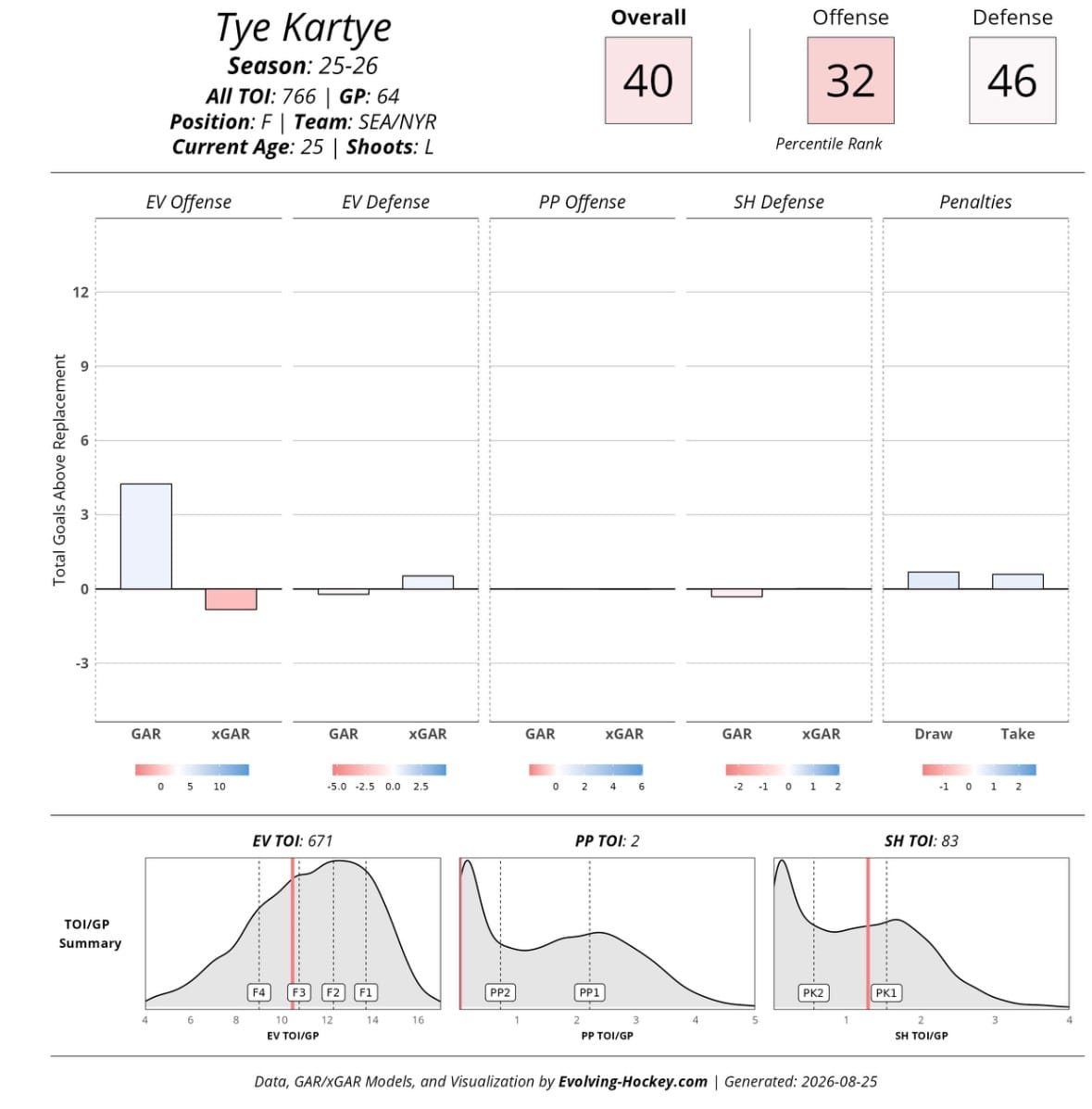
Kartye‘s Player Card from Evolving Hockey offers some reason for skepticism. Kartye finished in the 40th percentile overall, 32nd percentile offensively, and 46th percentile defensively in 2025-26. His actual even-strength Goals Above Replacement was comfortably positive, but his expected GAR finished below replacement level. In simpler terms, the results were considerably better than what the underlying process suggested should have occurred.
That doesn’t mean Kartye’s production in New York was some kind of accident. There was more encouragement when looking at the lines he actually spent meaningful time on after joining the Rangers.
Nearly all of Kartye’s five-on-five minutes in New York came on two combinations. The trio of Conor Sheary, J.T. Miller, and Kartye played 134:26 together across 15 games and controlled 52.9 percent of the expected goals, 53.2 percent of the scoring chances, and 54.2 percent of the high-danger chances while breaking even 8-8 in actual goals.
Kartye also played 80:37 with Sheary and Noah Laba across nine games. That line controlled 51.6 percent of the shot attempts and outscored opponents 5-2, although its 48.7 percent expected-goals share was less encouraging.
Across those two combinations, the Rangers outscored opponents 13-10 while controlling 50.6 percent of the shot attempts, 51.6 percent of the expected goals, and 52.2 percent of the scoring chances. In other words, despite Kartye’s less impressive individual underlying numbers, his most frequently used lines generally tilted play in New York’s favor.
BenchRates paints an encouraging picture of his overall value, as well. Its model valued Kartye’s total 2025-26 contribution at approximately $2.8 million, including $2.3 million in what the site classifies as paid contribution and another $475,000 in unpaid contribution. That came while Kartye carried a $1.25 million cap hit.
Then there is the part of his game that requires considerably less projection.
Kartye finished 2025-26 with 173 hits in 64 games, including 75 in his 24 games with the Rangers. That followed 229 hits as a rookie and another 175 in 2024-25. He has now recorded 577 hits in 204 NHL games, an 82-game pace of approximately 232.
The Rangers should not enter this season expecting Kartye to score at the rate he did after arriving in New York. Nothing in his first 204 NHL games or his underlying numbers suggests that would be a particularly reasonable bet.
But he doesn’t need to.
If some portion of that offensive improvement sticks while the physicality, forechecking, and penalty-killing role remain, the Rangers will still have a useful bottom six forward on their hands.
Expectations
At 25 years old and with 204 NHL games under his belt, he’s no longer an unknown quantity. The physicality is established, the Rangers know he can contribute on the penalty kill, and his stint in New York showed there may be more offense available than his first two seasons in Seattle suggested.
The challenge now is turning those pieces into a consistent role over a full season. However, his usage last season offers a pretty clear starting point.
Kartye logged 83 minutes shorthanded and only two minutes on the power play, according to Evolving Hockey. That is unlikely to change dramatically. His path to consistent playing time is going to run through the bottom six, the penalty kill, and the parts of the game that don’t require him to have the puck on his stick.
One of the more encouraging things about Kartye’s brief run in New York was that he produced respectable results in two distinctly different combinations. He spent significant time with J.T. Miller and later with Noah Laba, and neither line was overwhelmed. That gives the Rangers some flexibility to move Kartye around the bottom six rather than treating him as a winger who can only function in one particular spot.
The physical element should remain a major part of what he brings. Kartye has surpassed 170 hits in each of his three full NHL seasons and has shown no indication that he plans on suddenly becoming shy about finishing checks. That forechecking pressure can have value beyond the hit totals themselves, particularly if it helps the Rangers sustain offensive-zone time and makes life easier for whichever center he plays alongside.
Where Kartye can raise his ceiling is with the puck.
Now Kartye and Duhaime drop ‘em! #NYR pic.twitter.com/SYso5ufgM3
— Snark Messier (@SnarkMessier) April 6, 2026
Nobody should expect him to become a major offensive driver, but there is a meaningful difference between a bottom six forward who provides little scoring and one who can contribute 20-plus points without sacrificing the rest of his game. Kartye showed during his 24 games with New York that he is capable of finishing plays and contributing offensively when opportunities are there. The task this season is proving that some of that production can survive a much larger sample.
There is room for improvement in the underlying numbers, but Kartye did take a meaningful step forward after joining the Rangers. At five-on-five, his expected-goals share improved from 42.1 percent with Seattle to 47.8 percent with New York, while his scoring-chance share climbed from 47.0 percent to 49.6 percent. The biggest jump came in high-danger chances, where Kartye went from controlling just 38.7 percent with the Kraken to 47.8 percent with the Rangers. His 48.5 percent Corsi share in New York was an improvement from 47.1 percent in Seattle, as well. None of those numbers suggest Kartye was driving play at an especially high level, but the across-the-board improvement provides some reason to believe his better results in New York weren’t entirely driven by a scoring hot streak.
That progression is what the Rangers should want to continue this season. If Kartye can push more of those five-on-five shares toward or above 50 percent while maintaining the physicality and penalty-killing role that already earn him minutes, he becomes a considerably more dependable bottom six option.
The penalty kill will be another area worth watching. Kartye was already being used shorthanded before he arrived in New York, and that responsibility carried over with the Rangers. Becoming someone the coaching staff can consistently trust in those situations would give him another avenue to stay in the lineup even during stretches when the offense isn’t there.
This season also carries some longer-term significance. Kartye is entering the final year of the two-year contract he signed in July 2025 and will be a restricted free agent next summer. By then, the Rangers should have a much clearer idea of whether they view him as interchangeable depth or as someone worth keeping as part of their bottom six.
The standard for Kartye doesn’t need to be complicated. Play physically, help the penalty kill, avoid becoming a liability at five-on-five, and contribute enough offensively to give the Rangers something more than a traditional checking winger.
If he can do all of that consistently over 82 games, his place in the lineup should take care of itself.
Predictions
76 GP | 12 G | 19 A | 31 PTS
These are admittedly modest predictions, but that feels like the appropriate course of action for a player whose value is likely to come more from consistency than from any dramatic statistical breakout.
First Prediction: Tye Kartye finishes with 12 goals and 31 points.
That would represent a modest step forward from last season without requiring him to maintain the scoring pace he posted after arriving in New York. It would also give the Rangers useful secondary production from a bottom six winger, especially with a player like Sam Carrick gone.
Second Prediction: Kartye records more than 200 hits, and remains a regular on the penalty kill.
The physicality is probably the safest projection in his profile. He has already shown he can sustain a high hit rate over a full season, and his shorthanded usage should continue to give him a role even when the offense fluctuates.
Final Prediction: Kartye spends most of the season as a lineup regular, rather than rotating in and out of the bottom six.
His ability to contribute physically, kill penalties, and provide at least some offense gives him more ways to stay in the lineup than a one-dimensional depth forward. Barring a significant decline in his five-on-five play, he should have a fairly stable role.
The Bottom Line
Kartye doesn’t need to become something he isn’t for this season to be a success.
The Rangers already have enough evidence to know what he brings physically and away from the puck. What they still need to learn is whether the offensive bump he showed after arriving in New York can settle into something sustainable over a full season.
If it does, even modestly, Kartye becomes exactly the kind of player teams want in their bottom six: inexpensive, reliable, difficult to play against, useful on special teams, and capable of contributing enough offense that he isn’t simply surviving his minutes.
There probably isn’t some massive breakout coming here, and there doesn’t need to be. Kartye’s path to becoming more valuable isn’t about suddenly turning into a scorer. It’s about making the Rangers trust him in more situations while continuing to chip in offensively when the opportunities are there.
That might not be the most exciting outcome imaginable.
But, it’d still be a pretty good one.