MTPS: And the Mika Shall Inherit the Earth (or Southern California)
Mika was once the best deal the Rangers made in a generation—now he might be their best path forward. A deep dive into his rise, decline, and a bold trade proposal.

Let us begin at the beginning.
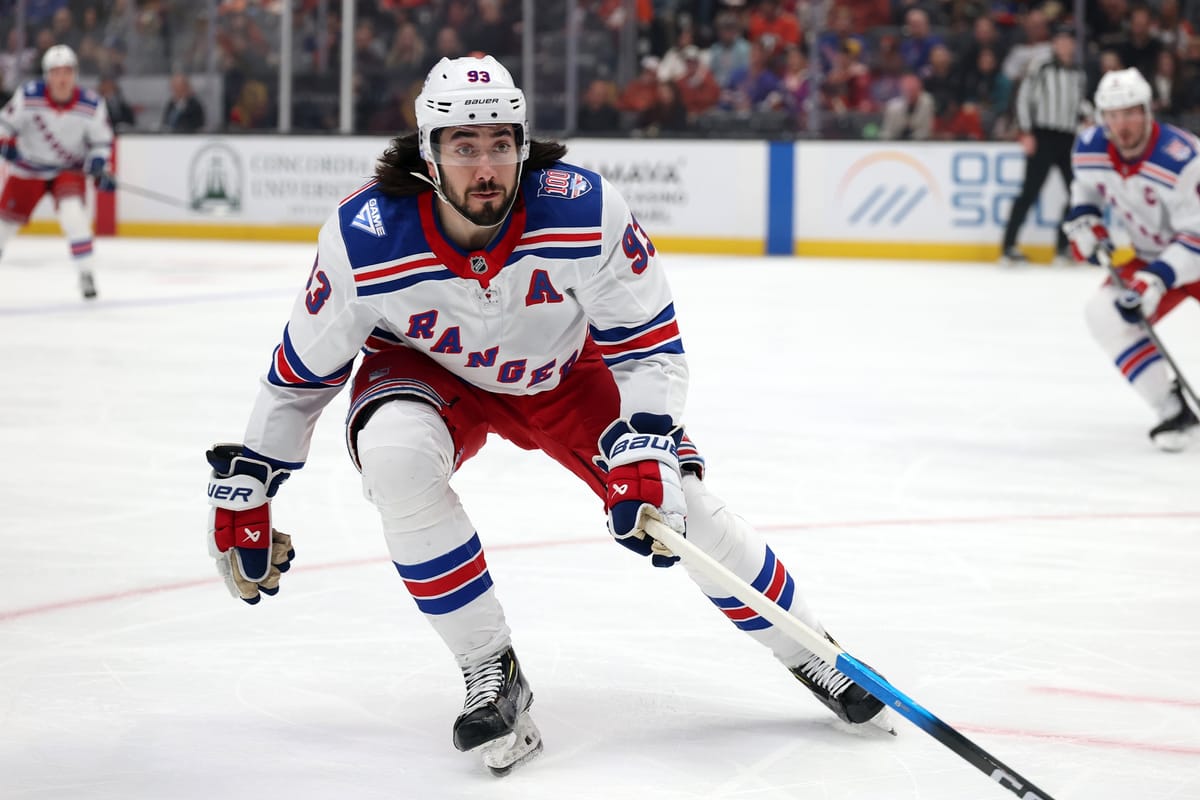
On July 18, 2016, The New York Rangers acquired Mika Zibanejad and a second round pick from the Ottawa Senators for Derick Brassard and a seventh round pick. Brassard was a popular and productive player here in New York, he was only 28, and (at the time) there were reasonable questions about why Jeff Gorton was flipping him for a 22-year-old relative unknown.
When you reflect on the last two decades of Rangers transactions, you would have to say that this deal is up there with acquiring Adam Fox for a couple of draft picks, and trading Scott Gomez for Ryan McDonagh (Jaromir Jagr was acquired 21 years ago, so that deal falls outside the two decade parameter). Mika came in and went from steady to spectacular. I will forever wonder what his final stat line would have been had COVID not caused the suspension of the 2019-20 season—a season where Mika recorded 75 points (41 goals) in only 56 games. We do not talk enough about how great Mika was after coming here. And there's a reason for that.
On Oct. 10, 2021, Chris Drury followed up what was just a brutal offseason in which he traded Pavel Buchnevich for Sammy Blais, acquired and extended Barclay Goodrow, and hired Gerard Gallant, by signing Mika to a max-term (eight years) contract with an $8.5 million AAV and carrying a complete no-movement clause.
The deal requires some context:
- First and foremost, Mika was coming off another strong season. While his numbers weren't close to what they were the year before, he was second on the team in scoring with 50 points (24 goals) in 56 games. A deeper dive would show that most of that damage came on the power play and so there were a few red flags, but at the time this was a very reasonable deal.
- Additionally, Drury really had no options. Jack Eichel had been traded to Las Vegas, Aleksander Barkov had only days earlier signed an extension that took him out of free agency, and the Rangers had no center depth.
Everyone knew (or assumed) that a contract that would take Mika into his mid/late 30s would end poorly. No one imagined it would go so sour so quickly.
Mika's next two seasons were good. Really good, in some ways. He was a point-per-game player or better but it felt like a lot of those were "empty calorie points," or that he, like much of the rest of the team, was feasting on the power play and not able to do much at even strength. After that though, the wheels fell off and Mika became a shell of himself, emerging only towards the end of the season for what Joe Fortunato would call "Mika March," the annual spring event where Mika would put on a show that would result in full season numbers that were, while not spectacular, at least respectable. With COVID-imposed measures strictly limiting salary cap growth, and the Rangers in desperate need of an influx of talent, we stopped looking at Mika Zibanejad as one of the best players this organization has ever traded for and started looking at him as an albatross.
When the Rangers acquired J.T. Miller from the Vancouver Canucks last year, one of the things that we all agreed upon was that carrying three centers over 30 was a bad idea. We just disagreed about who should go.
Joe was adamant it needed to be Mika:
The risk the Rangers assume is they have two 31-year-old centers (err, center and a right winger; more on this in a minute) who make a combined $16.5 million until 2030. Which leads us to ...
Mika Zibanejad. I don't think it's a stretch to say Chris Drury's top priority is removing him from the team's roster this summer. I've come around, especially after the Miller deal happened without him going the other way, to that being a summer project that likely can't be done in season. Fine. It is what it is.
The bigger issue is his full no-movement clause. I know Zibanejad has made comments about "earning" it, and it seems like this is the place he wants to be. That's great, but things change, and as Eric continues to remind you on the podcast: Drury has already done tough things to get Jacob Trouba and Barclay Goodrow off the books and Zibanejad would just be that on steroids. If it gets really messy, then so be it. It's already pretty messy if we're being honest with ourselves.
I wanted Trocheck gone instead. Like my boys Marshmello and Kane Brown sang, "I've been wrong about a million times, but I got one thing right."
I have repeatedly referred to Mika as tofu. You can marinate chicken or beef or shrimp in any number of things, but they all retain some of their original flavor when cooked. Tofu has no flavor. It is the perfect, neutral vessel for carrying the flavor of something else. That's Mika. If you surround him with someone who plays an up-tempo, nasty game, then Mika will play that game. If you put him with someone who plays an east/west, soft skill game, then Mika will play that game. Since Miller got here, Mika's game has rebounded. He's playing with more passion, more pace, and a nastier edge. He's looking like the player Drury extended.
And, because of all of that, it might be time for him to go. How many teams do you think would love an all-situations center with Mika's offensive game for four years at $8.5 million per year? The answer is, "almost all of them."