2026 Rangers Season Previews: Mika Zibanejad
What a difference a year makes. Zibanejad rebounded last season. But with four years left on his contract, can he continue the positive trend?

This article is part of an ongoing series of New York Rangers Season Previews, taking a close look at what we can, and should, expect from each member of the 2026-27 New York Rangers. To read other articles in this series, go here.
A year ago, Mika Zibanejad entered training camp as one of the biggest question marks on the New York Rangers’ roster.
Now he’s coming off a 34-goal, 78-point season in which he led the Rangers in both categories and tied for the team lead with 44 assists. He was also named Team MVP by the New York media and won the Players’ Player Award in a vote by his teammates. Not to mention the fact that Zibanejad also won the Steven McDonald Extra Effort Award—the annual fan-voted honor recognizing extraordinary effort—for the third time, becoming the 38th recipient in the award’s history.
Congratulations to Mika Zibanejad on being named as the winner of the Steven McDonald Extra Effort Award for the third time in his career.
— Snark Messier (@SnarkMessier) March 31, 2026
It’s been a great season for Mika! #NYR pic.twitter.com/JJY3zQXTQC
Funny what 34 goals will do for a narrative.
After consecutive seasons of declining offensive production, Zibanejad didn’t simply stop the slide in 2025-26. He reversed it. His 78 points were his most since recording a career-high 91 in 2022-23, and his 34 goals were his most in three seasons.
He also turned 33, crossed 1,000 career NHL games, and enters 2026-27 with four seasons remaining on a contract that isn’t going anywhere.
Mika Zibanejad, accompanied by his parents, his wife, Irma, his daughter, Ella, as well as some of his Rangers teammates, receives his silver stick.
— Snark Messier (@SnarkMessier) March 23, 2026
Congratulations on 1,000 games, Mika! #NYR pic.twitter.com/eqUtm2mBh2
So, the question surrounding Zibanejad has changed considerably over the last 12 months.
Last year, it was whether he could still be the player the Rangers were paying $8.5 million per season to be.
Now it’s whether he can do it again.
Previous Performance
Quite frankly, there wasn’t much subtlety to Zibanejad’s rebound.
After finishing 2024-25 with 20 goals, 42 assists, and 62 points in 82 games, he jumped to 34 goals, 44 assists, and 78 points in 81 games last season—a 25.8 percent increase in his total point production. His shot total climbed from 183 to 215, his shooting percentage jumped from 10.9 percent to 15.8 percent, and his average ice time increased from 18:46 to 20:54 per game. That’s the first time Zibanejad had an ATOI north of 20:00 since the 2020-21 season (20:06).
He led the Rangers in goals, points, power-play goals (16), and power-play points (35), while tying Adam Fox for the team lead with 44 assists.
The advanced numbers support the idea that this was more than Zibanejad simply rediscovering where the net was.
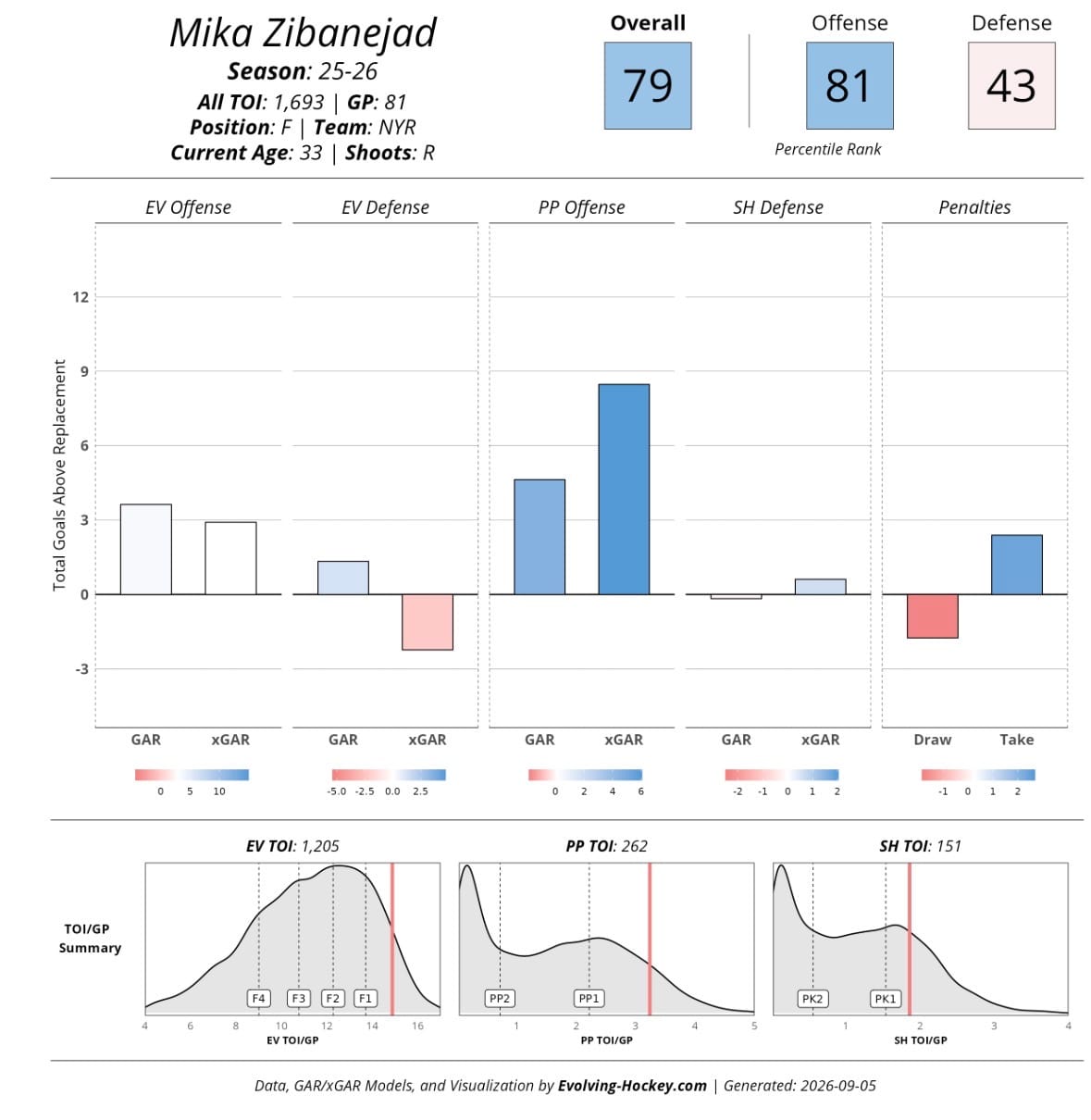
His Player Card from Evolving Hockey placed him in the 79th percentile overall and 81st percentile offensively in 2025-26. His defensive rating was considerably less impressive at the 43rd percentile, but his even-strength offense produced positive actual and expected Goals Above Replacement, while his power-play offense was one of the strongest portions of the card.
HockeyStatCards was similarly favorable. Its model credited Zibanejad with a +7.9 offensive rating, +3.9 defensive rating, and +11.8 Net Rating, second among Rangers forwards behind only former Ranger Artemi Panarin.
The 5v5 improvement is particularly encouraging.
According to the NaturalStatTrick data, New York controlled 50.5 percent of the expected goals with Zibanejad on the ice last season, up from 48.7 percent in 2024-25. His high-danger chance share jumped from 48.9 percent to 53.7 percent, while his scoring-chance share improved slightly from 50.0 percent to 50.4 percent.
The Rangers still controlled only 49.1 percent of the total shot attempts with Zibanejad on the ice, but that was also an improvement from 48.3 percent the year before.
2 GOALS IN 45 SECONDS FOR MIKA. #NYR pic.twitter.com/dRzlW1lqQv
— Snark Messier (@SnarkMessier) November 28, 2025
He produced more at 5v5, too. Zibanejad went from 11 goals and 31 points at 5v5 in 2024-25 to 16 goals and 37 points last season.
So, yes, the power play helped. Sixteen power-play goals tend to do that.
But this wasn’t exclusively a special-teams resurrection.
His linemates provide some additional context.
Zibanejad’s most frequently used combination featured Alexis Lafrenière and Gabe Perreault. That group played roughly 262 minutes together across 22 games, outscored opponents 14-10, controlled 52.3 percent of the scoring chances, and held a 53.1 percent share of the high-danger chances despite finishing just below break-even in expected goals at 49.4 percent.
The chemistry here is off the charts. #NYR pic.twitter.com/voqZc9VMym
— Snark Messier (@SnarkMessier) March 11, 2026
His next-most-used trio, with Panarin and Lafrenière, was almost the opposite story. That line controlled 55.4 percent of the shot attempts, 51.3 percent of the expected goals, and an impressive 59.0 percent of the high-danger chances, yet somehow got outscored 8-5, because hockey remains deeply committed to making sure the numbers never tell a completely convenient story.
Zibanejad also spent roughly 176 minutes alongside J.T. Miller and Perreault. That combination controlled 51.0 percent of the shot attempts, 53.4 percent of the expected goals, 56.2 percent of the scoring chances, and 56.5 percent of the high-danger chances while breaking even 10-10 in actual goals.
Across those three combinations—the groups Zibanejad played with most frequently—the Rangers outscored opponents 29-28 while controlling 51.5 percent of the shot attempts, 51.3 percent of the expected goals, 53.3 percent of the scoring chances, and 56.0 percent of the high-danger chances.
In other words, Zibanejad wasn’t being propped up by one magical line combination. He produced respectable underlying results with several different groups.
That matters quite a bit considering the people standing next to him are most likely about to change (yet) again.
Expectations
Zibanejad enters 2026-27 with considerably less uncertainty surrounding his position in the lineup.
Vincent Trocheck was traded to the Utah Mammoth on July 1, and PuckPedia currently lists Zibanejad as the Rangers’ first-line center, although exactly who will flank him remains unsettled.
That seems like a pretty reasonable place to begin.
Zibanejad spent extensive time with Lafrenière last season, including on each of his two most frequently used lines, so there shouldn’t be much of an introduction period required there.
Pavel Dorofeyev is one of the more intriguing possibilities on the opposite wing.
The 25-year-old scored 37 goals and 64 points for the Vegas Golden Knights last season, adding another 16 points in the postseason, before the Rangers acquired him during the NHL draft. If head coach Mike Sullivan puts that kind of finishing ability alongside Zibanejad, New York would have something it hasn’t exactly been overflowing with lately: another guy who can put the puck in the net on purpose.
And Zibanejad’s own shot certainly doesn’t appear ready for retirement.
NHL EDGE clocked his hardest shot last season at 96.39 mph, which ranked in the 98th percentile among NHL forwards—the question is how many of those shots will continue going in.
Zibanejad’s 15.8 percent shooting rate last season was well above the 10.9 percent he posted in 2024-25 and above his 13.3 percent career rate. That creates an obvious regression concern, but it isn’t as though 15.8 percent came completely out of nowhere. He shot 15.5 percent during his 39-goal season in 2022-23 and an absurd 19.7 percent during his 41-goal, 57-game campaign in 2019-20.
Nobody should pencil him in for another 34 goals solely because he did it last season.
The power play will be a major part of determining where he lands.
Zibanejad scored 16 times on the man advantage last season and has already become the Rangers’ franchise leader in career power-play goals. His Evolving Hockey Player Card reflects just how valuable that part of his game remained, and there’s no reason to expect him to suddenly disappear from the Rangers’ top unit.
The personnel around him, however, will be different.
Panarin is gone. Trocheck is gone. Dorofeyev is here. Gabe Perreault is another year older. Lafrenière will be expected to shoulder more offense.
That makes Zibanejad one of the few established constants in a top six that has undergone substantial change.
There’s also considerably less reason to experiment with him on the wing.
Zibanejad has shown he can play there, particularly alongside Miller, but trading Trocheck removed one of the Rangers’ established top six centers, so they’ll certainly need Zibanejad to stay put going forward.
At 33, Zibanejad is entering the fifth year of the eight-year, $68 million contract he signed in October 2021. He carries an $8.5 million cap hit through the 2029-30 season and has a full no-move clause throughout nearly the entire remaining term.
There is no youth movement coming to take those minutes away from him. There is no expiring contract that makes this someone else’s problem next summer. This is the arrangement.
The good news is that the 2025-26 version of Zibanejad remains plenty good enough to make it work.
And, while it would be lovely, the Rangers don’t need another 91-point season. They don’t need him flirting with 40 goals. They don’t even necessarily need another 78 points.
They need the 5v5 play to remain around break-even or better, the power play to continue running through his shot, and the offense to stay comfortably above the level that caused so much concern two seasons ago.
Predictions
80 GP | 31 G | 43 A | 74 PTS
These aren’t particularly aggressive predictions, but expecting a little regression from last season’s shooting percentage without predicting the complete disappearance of Mika Zibanejad feels like a reasonable compromise.
First Prediction: Zibanejad scores 31 goals and finishes with 74 points.
That would represent a slight step backward from his 34-goal, 78-point season without undoing the gains he made last year. If the power play remains productive and his 5v5 results stay respectable, another 70-plus-point season should be well within reach.
Second Prediction: Zibanejad scores at least 12 power-play goals and finishes with more than 30 power-play points.
The Rangers’ personnel has changed, but his role shouldn’t. His one-timer remains one of the most dangerous weapons on the roster, and there’s little reason for Sullivan to stop using it. We all know Zibanejad is a power-play merchant, but he’s thrived so much on the man advantage for the Rangers that expecting a solid chunk of his total production not to come from it would be foolish.
Final Prediction: Zibanejad plays his best hockey with Lafrenière and Perreault.
There’s a pretty compelling reason to believe that combination has more to give.
From Feb. 26 through the end of the regular season—a stretch that included the trio becoming a regular line together in early March—Zibanejad produced 11 goals and 26 points, Lafrenière had 12 goals and 25 points, and Perreault added nine goals and 19 points.
The underlying numbers were encouraging, too. During that span, Zibanejad posted a 54.4 percent expected-goals share and 56.7 percent high-danger chance share. Lafrenière was at 52.3 percent and 56.6 percent, respectively, while Perreault finished at 51.4 percent and 52.7 percent.
There was certainly some finishing luck involved—each of them shot better than 17 percent during that stretch—but the combination wasn’t surviving on shooting percentage alone.
Perreault gives the line a creative playmaker, Lafrenière can attack off the rush and around the net, and Zibanejad still provides the shooting threat through the middle. More importantly, their individual production took off during the same late-season stretch in which Sullivan began using them together regularly.
If that trio gets an extended run in 2026-27, I think that’s where we’ll see Zibanejad’s best and most consistent 5v5 hockey.
The Bottom Line
Zibanejad doesn’t need another redemption season.
He already had one.
What he needs now is confirmation.
At 33 years old, nobody should reasonably expect him to recreate the ridiculous 41-goal pace of 2019-20 or suddenly establish a new career high in points. But last season demonstrated that the player who looked like he might be entering a steep decline in 2024-25 still has plenty left.
And hey, if things don’t work out, and Zibanejad regresses to the point of irreconcilable frustration, at least he has that DJ career to fall back on.